Resources on Disproportionate Suspension Rates and Law Enforcement in Schools

2 min read

A quick and incomplete list for some research I'm doing on the use of law enforcement (often called School Resource Officers) in schools. From what I have seen (and if I'm wrong here, please set me straight in the comments and I'll update the post) districts don't track the use of SROs in discipline for behavior referrals for minor offenses in any uniform way, if at all.

If this is accurate, we have a population of students who face out of school suspension for minor offenses, combined with a referral to law enforcement for the same offense - and we have no information about the number of students affected by this practice.

As a side note, in the 19 states that still allow corporal punishment, there are districts where SROs or local law enforcement deliver the beatings. Again, I have not seen any data quantifying how widespread this practice is.

Updates

Items added after the original post.

, ,

The Long Life of a Data Trail

9 min read

Within educational technology, tech companies can acquire data via multiple routes. The most direct way is via a direct signup: a teacher creates an account to use a service, and the teacher is the only person using the service. BetterLesson is an example of a site like this - a teacher creates an account, and only teacher data gets collected. The site is primarily teacher focused.

A second model includes sites that get their initial data from teacher or school signup, but then as part of the service offered in the site, they acquire student information. Basic gradebook applications and some simple student information systems work like this - the teacher or school signs up for the application, and in the process of using it they enter student names, grades, notes, parent information, and other details - the actual data added will vary based on the needs of the application, but information is shared about people without their direct involvement or consent. Online IEP programs also fit this description. While the teacher or school provisions the account, the vendor ends up getting additional data through the teacher's use of the account. In this model, students and parents do not use the service directly, but data about them is collected and stored in the service as teachers use the service.

A third model involves a teacher, school, or district creating an account on the service, and either creating accounts for their students/parents or using an invitation process. In this version, teachers, students, and potentially parents sign up for and interact with the service. The data trail here involves information about all participants that includes personally identifiable information, location data (via IP addresses and/or phone GPS location), and behavioral and interaction data pulled from time spent using the service. Examples of services like this include many EdTech products out there, including Edmodo, Remind, ClassDojo, Schoology, most digital text offerings from traditional publishers like Pearson and McGraw Hill, learning programs like Agilix Buzz, and app ecosystems like Amplify tablets, iPads, and Chromebooks.

A fourth model that collects both learner and parent data includes apps for kids, marketed either to parents or to children. Examples of applications like this include most educational apps sold in the Apple and Google app stores, and some online learning sites. Because these apps are built to be used outside of schools, the data collected by them is not considered an educational record under FERPA, and is therefore covered by the privacy policies and terms of service put in place by the app vendor. If the app is primarily intended for children under 13, parental signoff (and therefore parental data) is often required for use.

The fifth model includes highly structured datastores to collect longitudinal data, and glue services that integrate multiple external services. These applications can support both storage of and analysis on data collected in a variety of applications. A very incomplete list of examples here include Knewton, Infinite Campus, eScholar, Schoolnet, Learnsprout, or Clever.

Context of EdTech Data Collection

The context around educational data is arguably different than data collected in consumer technology. In both K12 and Higher Ed, schools can sign up for services that students use directly, and in many of these cases student data is uploaded before students or parents are consulted. For example, if a teacher signs up for Remind, parents aren't asked if their contact information gets shared as part of an "invite" feature. While many consumer tech apps include invite features, EdTech apps are used within a different context. When a student or a parent sees an app or an invite coming from a school or a teacher, there is a level of implied trust. Increasingly, the implicit trust that students and parents give schools and districts appears to be unearned.

Data Privacy Plays Out Over Time

Unless data collected by an app is deleted or destroyed - and this includes data in backups and in systems that provide redundancy - we need to start thinking of data trails as timeless. This means that a data trail can be transferred from one entity to another if the conditions allow these transfers to occur. In technology, the Terms and Conditions and Privacy Policies are where we can see the conditions in which our data trails are preserved.

While Privacy Policies and Terms of Service should be read in full (free login required for access), for the purposes of this post we are going to focus on two specific sections that can be used to gut the terms in any policy: how policies can be changed, and how data is treated in case of sale, merger, or bankruptcy.

Changes to Terms

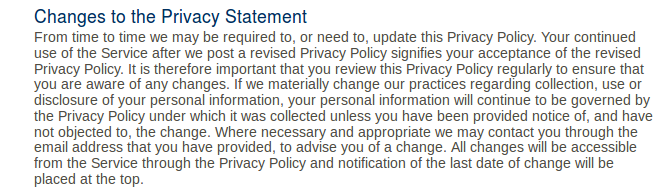
Over time, a site's policies should change. Unfortunately, many sites specify that terms can be changed at any point, with no notice to end users, and with no explicit signoff from end users. Many sites state that visiting a site or logging in to a site means that a user accepts the updated terms - so, the simple act of reading updated terms gets interpreted as "acceptance" of the terms. Even on sites that have better notification policies (and at this point, the "best" policies generally include an email and a banner on the top of the site), users often have no recourse (aside from stopping their use of the site) if they don't like the updated policies. Additionally, many sites do not allow users to delete their data from a site, so even if they stop using a site, their data is still stuck in the site.

The ShareMyLesson Privacy Policy uses pretty typical language:

ShareMyLesson Privacy Policy Screenshot

To summarize: most sites reserve the right to change their terms whenever they want, with minimal notification, and no option to remove data. In the case of a site where a learner has been added to a site by a school or district, learners have even less recourse.

Data Transfer During Sale, Merger, or Bankruptcy

While a sale, merger, or a bankruptcy are three very different events, most privacy policies treat them identically: if it happens, user information is an asset that gets sold.

Edmodo's privacy policy, shown in the screenshot below, is pretty standard for EdTech terms:

Edmodo Privacy Policy Screenshot

For a start, the weak terms used throughout EdTech could be improved by the following four changes:

  • Users opt in to changed terms, and/or export data as part of an account cancellation process;
  • User opt in when data is transferred to a new owner;
  • User account cancellation/data deletion as a regular feature available to users of the app;
  • In case of a bankruptcy or going out of business, user data gets destroyed and is not treated as an asset.

These four changes would ensure that user awareness and buy in is included as a factor when terms are changed. There are additional ways that vendor practices could be improved, but starting with these four would be a solid beginning.

Who Cares Where Data Ends Up? It's Only School!

Data brokers care.

They have created lists of victims of sexual assault, and lists of people with sexually transmitted diseases. Lists of people who have Alzheimer’s, dementia and AIDS. Lists of the impotent and the depressed. There are lists of “impulse buyers.” Lists of suckers: gullible consumers who have shown that they are susceptible to “vulnerability-based marketing.” And lists of those deemed commercially undesirable because they live in or near trailer parks or nursing homes. Not to mention lists of people who have been accused of wrongdoing, even if they were not charged or convicted.

In the housing market, we have examples where information from data brokers was used to discriminate based on race. If you're looking for a relatively benign example (if you can get through the marketing speak) of how data from brokers can be mashed up to create profiles, spend some time on this zip code profiler put out by ESRI. It's worth noting that the profiles were created based on aggregated data of individuals, so that the summaries here are the result of millions of data profiles on individuals. The description of how the site was put together provides a superficial glimpse of how data on individuals from multiple sources can be combined to tell a story.

Now, imagine the increased accuracy that could be added to personal profiles if they are fleshed out with datasets that contain personal information, starting with habits formed in elementary school.

The life of a data trail matters.

Conclusion

When a student is signed up for a service by a school or teacher, data is collected from people who have no say in forming the relationship or shaping the terms of the deal. In some cases, this involves student work being sold without student knowledge. The fact that EdTech companies treat student data (which really is a track record of learning, personal interest, and growth) as an asset to be bought or sold is on very shaky ground, both pedagogically and ethically. Given that a learning record is also - to an extent - a snapshot of behavior, and that behavioral info is gold for marketers, it raises the real question: why should edu records ever have the possibility of ending up outside an educational context? Treating records as a financial asset that can be acquired in a merger/bankruptcy ensures that some records end up being used outside an edu context. The combination of the "fail faster" mantra of VC funded tech, combined with ongoing deals - over 8 billion dollars worth in 2014 alone - ensure that student data is getting sold and used outside an educational context.

When a technology company reserves the right to sell user data in case of bankruptcy, they are hedging their bets. By claiming a stake in user data - instead of getting firmly behind their product or service - they are telling us that they do not have complete confidence in their product. And when a company tells us that: we should listen, and return the favor. If a company doesn't have enough faith in their product to leave user data off the table as an asset, we should match their level of faith - and not use their product.

, ,

Lesson Plan: Deconstructing Racism and Bias in the Media

4 min read

This lesson is based on events from late October/early November in Minnesota. It would be a good fit for grades 6-12. It is released (like all the blog posts on this site) under a Creative Commons Attribution Share-Alike license, which means that you are free to use it and modify it as you need, provided you share your work as well. The full content of this lesson is also available as a Google Doc that you can copy and modify as needed.

In this exercise, you will get directly into issues of race, power, and how bias in the media can affect what gets packaged as news. These are difficult but important topics. As a teacher, you might feel uncomfortable getting into these topics. When discussing issues that are outside your comfort zone or immediate area of expertise, be clear and transparent about where you are at. It is always okay to let your students know that you are learning alongside them, and that learning is a lifelong process that requires constant thought, evaluation, and growth - continuing beyond school. Depending on where you teach, your students will have varying levels of familiarity and comfort with the events described in this lesson. In short: spend time listening to your students, and meet them where they are at. Your role is not to control the conversation, or lead anyone to a specific conclusion. Your role is to provide a space where people can explore, make mistakes, speak freely, and draw conclusions.

As you introduce the lesson, let your students know that the lesson addresses issues of race, civic engagement, and power. You do not want students to be blindsided.

Once the lesson has been introduced, watch this video about a group of people doing neighborhood canvassing in a get out the vote effort. Background info that might be needed to add context to this video includes what canvassing is, how get out the vote drives work, how the push for recent voter ID laws make it more difficult for people of color to use their voting rights, and how people convicted of crimes can lose their right to vote.

Watch this video about a group of people doing neighborhood canvassing in a get out the vote effort.

After watching this video, discuss these questions:

  • Why do you think this video was made?
  • What is the overall point of this video?
  • How does this video address issues of race, power, and/or social status?

Then, watch this news report that uses one specific moment of the first video.

After watching the second video, start with the same questions as above:

  • Why do you think this video was made?
  • What is the overall point of this video?
  • How does this video address issues of race, power, and/or social status?

Follow up questions could include:

  • How does taking this single picture out of context distort the meaning of the original "get out the vote" event?
  • What details does the reporter leave out of his story? What explanations could exist for leaving out this background detail?
  • How does it undercut the reporters version of events, and the testimony of other people in law enforcement, that the police chief participated in the same "get out the vote" event?

The most appropriate followup discussions will be shaped by the questions raised by your class. Different students will need different levels of support and feedback.

Follow up note and resource: after I published this post, Melissa Harris-Perry summarized the issue and interviewed Navell Gordon, the man whose picture was taken with the mayor of Minneapolis.

Conclusion

The stories that we tell matter. How details are selected and highlighted can (including in this lesson) shape the message that is told. Pictures might be worth a thousand words, but in the hands of a storyteller (and just about all media is a form of narrative) context can be shifted to suit needs that are not remotely ethical or honest. Deconstructing narrative requires an awareness of how stories are constructed. Comparing these two videos, and looking at how the second plays upon fears and stereotypes, provides a concrete example of how "news" can be bent to support a narrow, fear-based view of the world.

, , , , ,

Filtering and Surveillance Should Not Be Considered Protection

11 min read

Yesterday, two applications that use student and parent data were written up on EdSurge. Both of the applications put student social media use under surveillance, and attempt to tie this surveillance and data collection to the students' best interest.

The two apps are Securly and Mevoked - Securly describes itself as a "filtering 2.0 for schools and families"; Mevoked describes itself as "bridging the gap between mental health and technology".

Securly

In the EdSurge piece, a director of instructional innovation describes what Securly offers:

From the Securly dashboard, the administrators can see what students have and haven’t been able to access,” she explains. “If I want to see what kids are posting on Twitter or Facebook, I can--everything on our Chromebooks gets logged by Securly."

So, let's parse this out. Securly logs and tracks what kids are doing on Facebook and Twitter. Because these activities are on Chromebooks, we can assume some level of email, search, and docs logging, at the very least. But it's necessary to remember that technology is not neutral, and that the direction a technology takes can be shaped by the context within which it's used.

The social media filtering makes an especially significant difference at schools like [name redacted], a Catholic all-girls high school where most students bring their school-supplied Chromebooks home. “Most of our students are economically disadvantaged, and use our device as their only device,” [name redacted] explains. “Students take Chromebooks home, and the Securly filters continue there.”

So, at a Catholic girls school serving poor kids, the school issues a device to all students that tracks their online behavior, fully aware that for many of their kids this is their main conduit to the internet. I can only imagine what a response to a kid would look like if/when a student at the school looks for resources on coming out, or looks for resources or protection from abuse.

And in case anyone was unclear on the vision and direction of the company, Awais Ahsan, the company founder, lays it out:

Ahsan envisions Securly as eventually connecting educators and parents in monitoring all social use of technology by students. “A tool for parents to log in and see a view for their particular child, and have alerts through SMS for these activities, would complete the picture in our eyes,” he says.

Nothing supports student autonomy and growth like text messages to parents when their kid is searching online. As to any argument that online learning can support open ended inquiry, or that personal interests can inform and drive a student's academic growth? Nope.

Ahsan reminds that so far, Securly only functions on school-issued devices, which students ostensibly should not be using for personal social media use in the first place.

Those pesky student interests should never get mingled in with the important stuff: teacher directed activities, which need to be constantly logged to protect kids.

It also bears highlighting that describing an internet filter and activity tracker as a bullying prevention tool is some incredible marketing spin.

Mevoked

Mevoked has some similarities to Securly, with a different focus. The following quotation is from the EdSurge piece and Mevoked founder Arun Ravi:

Like Securly, Mevoked analyzes social mobile and online data, but focuses on mental health and connecting individuals with online and in-person resources. “We want to fill in the gap of identifying negative behavior and be the conduit to managing your condition,” Ravi says.

While the precise nature of the "condition" requiring management remains vague, we clearly need data to do what we need to do. With regards to data collection and analysis, Mevoked falls back on the "Google is already doing more of this" explanation:

Ravi explains that Mevoked accumulates data about how students use technology that is already largely accessible. “There’s no barrier in collecting this data,” he says. “We’re doing exactly what Google does when they advertise to you, using the same algorithms to assess mental health.”

While this comparison appears to create an odd parallel between advertising and mental illness, the statement doesn't hold up. Granted, Google sucks up data like a caffeinated Dyson salesperson, but Google is not selling a mental health big data app. The use of the data matters. Mevoked aims to use the data it collects to put pressure on teachers:

By offering Mevoked to schools, Ravi hopes “to put the onus on educators to take a more active interest” in student mental health.

To be very clear: increasing emotional support for kids in schools is a very good thing. But, contextualizing that support within a mental health framework is problematic, and placing non-mental health professionals on the front line with mental health issues has the real potential to do more harm than good. It's hard to tell what's worse: equipping teachers who may or may not have any expertise in mental health with a name of a student in need, or outsourcing these judgments to an algorithm outside any form of informed local professional review.

The EdSurge piece also cites an ongoing study of the app with Lewis & Clark College students. The article states that a "senior psychology major at Lewis & Clark ... is conducting the study with Mevoked." It's very unclear how and what the study includes, and what the level of supervision is, but the way the study is described it sounds like an undergrad psych major is running a study on classmates with the support of a tech company. I suspect and hope I am missing some key details here, because this work sounds like it tramples all over the gray area between a tech pilot and a research experiment on human subjects. I hope and trust that any work that asks students to share mental health data includes supervision of mental health and/or medical professionals. While this is likely/hopefully in place, any supervision is not mentioned in the article.

While I was writing this piece, the people running the Mevoked Twitter account reached out to dispute some of my descriptions of their privacy policy, and to highlight that they are likely pivoting to work more with adults. Moving away from direct outreach to schools would be a good thing, but even in the case of a full pivot to only working with adults, the privacy issues highlighted here still need clarification. I took a screenshot of the conversation, as well as of the Mevoked privacy policy in place when this post was written.

Online Filtering, Mental Health, Surveillance, and Privacy

After reading the EdSurge piece, I took a quick jump over to the privacy policies of Securly and Mevoked. I didn't do a full review of their policies, but a quick read showed some of the common issues where data could potentially leak out.

Securly - the monitoring and logging application used in a school serving "disadvantaged" kids - reserves the right to sell any data collected "in connection with a sale of all or substantially all of the assets of Securly or the merger of Securly into another entity". Additionally, Securly reserves "the right to fully use and disclose any information that is not Personal Information (such as statistics, most frequented domains, etc)." Based on the amount of data collected by a logging service (for example, imagine what you have done on your computer and on the internet in the last 45 minutes), Securly would appear to have a sizeable trove of data on student usage patterns. Securly also reserves the right to change their terms of service and privacy policies at any time, with no notice.

A reasonable person might expect that an app like Mevoked, aiming to "bridg[e] the gap between mental health and technology" would have a more solid privacy policy. However, Mevoked quickly dashes that expectation. Mevoked uses information collected from parents and about children to advertise to parents:

We may use information collected from parents,to send such users you (sic) news and newsletters, special offers, and promotions, or to otherwise contact such users about products or information we think may be of interest. We will not send marketing or promotional materials to children.

So, an app created to support mental health will use data collected within the app to market to parents. The opportunities for opportunistic marketing here are mind boggling - and one can only imagine what Big Pharma would do with this dataset. Of course, this trove of curated mental health data is also a business asset, and can be transferred with no conditions:

If we are acquired by or merged with another company, if substantially all of our assets are transferred to another company, or as part of a bankruptcy proceeding, we may transfer the information we have collected from you to the other company.

And, of course, data collected within Mevoked can be shared in aggregate or de-identified form:

We may share aggregate or de-identified information about users with third parties for marketing, advertising, research, or similar purposes.

This assumes, of course, that the dataset can be adequately de-identified, and won't be combined with any other external datasets. And we need to re-emphasize here: the dataset in question contains data points that create a partial picture of the mental health of individuals, tied to their identity, and their privacy policy doesn't mention anything prohibiting the recombination of the Mevoked dataset with other datasets.

Both the Securly and Mevoked terms could be dramatically improved by stating that user data will never be included as part of any sale or transfer. If Securly is serious about being a filtering tool, it should not attempt to make user logs an asset. With regards to Mevoked, given that the company collects and analyzes data around an individual's mental health, treating that information as a financial asset seems poorly thought out, at best. Mevoked should also restrict any advertising or marketing related uses of its data. People are going to Mevoked for mental health reasons, not to help marketers get better at selling, and using mental health data in any form - with PII, in aggregate, or de-identified - to fuel marketing seems uncaring.

Conclusions

If you are a parent, concern for your children is natural. It's something we live with. But addressing concern doesn't require constant surveillance, and throwing the data trail generated by that surveillance into the hands of a tech company. If you work in a school and you absolutely must filter, don't sell out your kid's online habits under a misplaced sense of "safety." If you are a kid, look for these intrusive devices, and ask pointed questions about them. If you encounter a filter, ask what is logged, and why. This is your education, and you deserve the freedom to pursue it on your terms, without having every keystroke logged. If you are a teacher who really thinks you need to intrude this deeply into your students lives to make a difference, check yourself.

If you are running a tech company that is selling to schools and will get information on children as a direct result of your app, set up privacy policies that actually protect privacy and respect student autonomy and experimentation. Until you do that, you don't deserve our trust. Funders - the more you fund companies that trample on user privacy, the more you strengthen the impression that you care more about profits than people. And journalists and tech writers - please, push back on the techno-utopian narratives that get pushed your way. Read privacy policies, and ask companies questions about them. Think about the implications of the software you describe. Don't be afraid to call bullshit when it's needed.

And, as always, it circles back to the role students play in the learning environments we create. Securly and Mevoked - like most every EdTech app out there - treat students like observed objects, rather than creative people with agency. The EdTech space is filled with people trumpeting the potential for student directed learning, and technology that reinforces the traditional paradigm of a teacher leading obedient students. We can't transform the process of learning while celebrating tools that remain rooted in the power structures we seek to change.

Please, Correct Any Misconceptions Here

I'm always open to the possibility/certainty that I have gotten something wrong. Please, if you see something here that is inaccurate, let me know.

, , ,

Privacy, Data Combination, and Why PII Can Be A Red Herring

11 min read

Last week, Snapchat had a security breach. The Snapchat response was pretty typical for Snapchat, and unconvincing: they blamed the data leak - over 100,00 pictures that were supposed to be "temporary" - on end users for using third party apps. But Snapchat's record here is spotty at best. In late 2013/early 2014, Snapchat leaked data of about 4.6 million users. Both of these data breaches at Snapchat were preceded by the revelation that the "vanishing" images sent via Snapchat were actually just hidden on your phone - and not deleted - in Snapchat's app. Predictably, Snapchat denied this basic flaw by saying that it's not a big deal because retrieving data is hard.

A few days after the most recent Snapchat breach, the Guardian reported that Whisper - an app used to anonymously spill secrets - was sharing data with the US Department of Defense, tracking the location of people who opted out of location tracking, and highlighting specific users for increased scrutiny.

Whisper provides this description of their service:

With Whisper, you can anonymously share your thoughts and emotions with the world, and form lasting and meaningful relationships in a community built around trust and honesty. If you have ever had something too intimate to share on traditional social networks, simply share it on Whisper!

Whisper responded that the Guardian article was filled with lies and inaccuracies, and the Guardian debunked these claims. Whisper rewrote their privacy policies four days before the Guardian story broke to allow the behavior described in the Guardian article, and Whisper had every right to do this because Whisper - like most tech and EdTech companies - can change the terms at any point, with no notice to end users.

Before the Whisper debacle, we had a blow up over Secret - the app of choice for anonymous harassment and bullying - that had received 36 million in VC funding. Apparently, the founder's apathy toward teen suicide was not a significant enough liability to discourage VC funding (although, in fairness, it does seem that some VCs stayed away from the company).

Jonathan Zdziarski has a solid writeup on Whisper's iOS app, and his piece is worth reading for many reasons, but especially for this universally relevant gem:

Tracking a unique identifier across the lifetime of an application could trivially be used by a company to build a history and profile for the subject, associating all of their former posts, photos, searches, and other stored data with a single identity. Any single message, then, containing identifying correspondence – or multiple messages containing different minor details that could be correlated to form an identity, will positively identify not only the user, but also correlate it to their entire history within the app. Further associating a GPS location to this data would, over the long term, easily provide enough information to determine the user’s identity, simply by analyzing the overlaps of geo-coordinates over a time period.

It also can't be emphasized enough that the data collected by Whisper - a unique device ID, IP addresses, browser, operating system, browsing habits, etc, all tied to a consistent, unique user ID - are pretty comparable to what most education technology companies collect from their users. To quote from the Guardian article this information allows tech folks to make the following claim about an individual, and mean it:

"He’s a guy that we’ll track for the rest of his life and he’ll have no idea we’ll be watching him," (a) Whisper executive said.

And please understand: the functionality of Whisper is different than that of EdTech apps. But, the underlying data collected by Whisper is very similar to many edtech apps. Zdziarski's writeup of the Whisper app (quoted above) contains many general truths that are equally applicable to EdTech applications. We need to start thinking about apps in two ways: first, the functionality they deliver, and second, the data they collect (and the potential uses of that data both on its own and when combined with other datasets) in the process of our use. We'll revisit this idea later in this post.

The backdrop to the slipshod privacy and security practices, paired with apathy toward user safety, buttressed by terms of service and privacy policies that are hostile to end users, is the violence levelled at people who have traditionally been underrepresented in technology. Rape threats, death threats, threats of violence against family members, harassment are often used to silence people. The experiences of Kathy Sierra, Anita Sarkeesian, and Brianna Wu all speak to the larger barriers - and aggressions and microagressions - routinely experienced yet rarely acknowledged by the "experts" - or the people with access to money - in the tech world. The silence of the EdTech world - and in particular, the silence of the "games will save education" and the "let's get more women in STEM" crowd - has been deafening, to the point where it borders on complicity.

To recap: we have an ecosystem of apps that routinely collect more data than they need to deliver the functionality they claim to deliver. We have companies that repeatedly show they care more about organizational growth than user privacy. We have a VC funding system that appears apathetic at best to user needs. We have all of these elements within a system that regularly turns a blind eye to the various facets of racism, sexism, misogyny, and violence.

And, all of these practices are supported by terms of service and privacy policies that empower the company over the end user.

A little while back, I wrote about Remind, and about how their "safe" application provides no way for teachers to actually verify the identify of any people who have joined any class. It's a "feature" of their "privacy" approach. Remind has received 60 million in VC funding. In fairness, the founder of Remind reached out to me after that post, and made the time to talk over these - and other - concerns, and they are in the process of reviewing these practices. But Remind gathers comparable data to Whisper, and then some, as - unlike Whisper - Remind harvests phone numbers from parents, students over 13, and teachers who install the mobile app, regardless of whether it's needed or not.

When users download and use our mobile application, we automatically collect IP address, device ID, device type, user agent browser, what OS they are running, whether or not you signed up on the web, and phone number. If a user is under 13 and using our Student Application we do not collect the device ID or IP address, we will only collect the device type and OS they are running.

Remind, like just about every EdTech company out there, contains clauses that define how data they collect can leak out to other sources. The first way is through partner agreements, and the second is in case of acquisition or bankruptcy. Edmodo's phrasing is comparable to Remind's, and both are comparable to just about every VC funded EdTech company currently in operation:

If Edmodo, or some all of its assets were acquired or otherwise transferred, or in the unlikely event that Edmodo goes out of business or enters bankruptcy, user information may be transferred to or acquired by a third party.

Given how some segments of the tech world fetishize failure, and how difficult it is for startups to achieve longevity the likelihood that learner data will be transferred via bankruptcy or acquisition via some of the apps currently in use is a certainty.

In the education space - and arguably, outside it as well - we need to expand how we think about data collection and data sharing. Personally Identifiable Information (or PII) is becoming increasingly meaningless. A device ID - a unique identifier on a piece of hardware - can serve as a proxy for an individual. Location data - even blurred location data - can be used to derive a person's identity with a high level of accuracy. From a privacy place, while PII matters, the true power of data - and the potential damage caused by abuses of that power - come when data from multiple sources is combined. If a dataset from an EdTech vendor is transferred as part of an affiliate agreement, or as part of a sale or bankruptcy, we lose control over the fate of our information.

The business of combining data is lucrative; currently around 4000 data brokers participate in a 156 billion a year market. Data brokers collect data on a range of subjects:

They have created lists of victims of sexual assault, and lists of people with sexually transmitted diseases. Lists of people who have Alzheimer’s, dementia and AIDS. Lists of the impotent and the depressed.
There are lists of “impulse buyers.” Lists of suckers: gullible consumers who have shown that they are susceptible to “vulnerability-based marketing.” And lists of those deemed commercially undesirable because they live in or near trailer parks or nursing homes.

The fact that these lists often contain inaccuracies doesn't prevent their use in a range of industries:

Typically sold at a few cents per name, the lists don’t have to be particularly reliable to attract eager buyers — mostly marketers, but also, increasingly, financial institutions vetting customers to guard against fraud, and employers screening potential hires.

Recently, in the build up to the housing crisis, we see big data from data brokers used to shape racist policies in the housing market:

Specifically targeted for subprime loans among the minority demographic were black women. Women of color are the most likely to receive subprime loans while white men are the least likely; the disparity grows with income levels. Compared to white men earning the same level of income, black women earning less than the area median income are two and a half times more likely to receive subprime. Upper-income black women were nearly five times more likely to receive subprime purchase mortgages than upper-income white men.
The services of data collection agencies made it easy for lenders who were able to buy information about a potential borrower’s age, race and income. Armed with that information, it was easy for lenders to target moderate-to-high income women of color.

When we think about privacy, we need to expand our view to include more than the data that gets collected, and focus on where that data can end up. Privacy policies, and user ownership of and control over their data, are central to this.

Think about teachers feeding interaction data into Edmodo. Think about Class Dojo collecting a detailed data store that could be used to identify (how teachers perceive) impulsivity or obedience. Think about student intellectual property taken without compensation by TurnItIn. Think about test data and college planning data collected and stored by ETS. Think about students in EAA schools in Detroit, Recovery District schools in New Orleans, KIPP schools in Los Angeles, having their learning habits observed and stored by Agilex. Think about the data sets on kids stored by Rocketship charters. Think about the data flowing into Schoolzilla.

We need to start looking at privacy, data collection, the lack of understanding of abusive dynamics, trends of tech and EdTech funding by VCs, as related. The issues discussed in this post are exacerbated by teachers who partner with companies - in the form of Brand Ambassador or Advisory programs - and then form a social media phalanx to insulate the companies from criticism. While most of these relationships are benign, these relationships are generally not disclosed, which creates some immediate conflicts of interest.

A complaint I hear frequently - often multiple times a day - is that addressing privacy issues feels overwhelming, and that there is no place to start. And yes, it definitely can feel overwhelming, but we all have the opportunity to start in on this every time we interact with technology. We start improving privacy when we call out abusive dynamics online. We start improving privacy when we let a vendor know we will not be using their app with students because of their privacy policies. We start improving privacy when we talk to our colleagues about how privacy - and respect for student data - informs our tech choices. We start improving privacy when we talk to our schools, our school boards, and our elected officials about the ways that current practice needs to improve. Vendors won't listen as long as people use products with bad policies, and VC funders will continue to fund these bad products as long as there is a chance for profit.

Improving FERPA Access and Awareness, in Portland and Beyond

6 min read

In late August, I wrote about how different school districts and charter chains informed people about FERPA rights via their web sites. In the small number of schools and charter organizations reviewed, practices varied widely. Some organizations had no information obviously accessible online, where a smaller number of organizations did a pretty good job of making information about FERPA available. As a continuation of that work, I wanted to look at how parents and students are notified of their FERPA rights in the back to school paperwork. Online resources are one facet of the issue, but many districts still rely on paper forms to both gather information from families, and inform families of their rights.

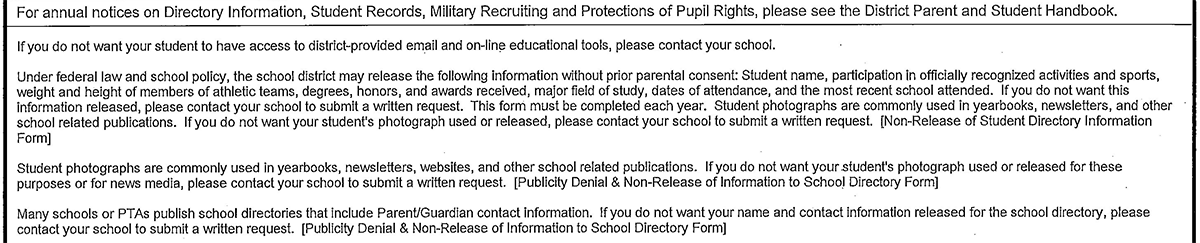
In Portland Public School District in Portland, Oregon, parents received intake forms to start the new academic year. This blurb about FERPA - but not mentioning FERPA by name - describes how parents and students can learn more about and hopefully access their rights.

This screenshot shows the text as it was sent home to parents:

The text below quotes the screenshot to make the language sent home to parents more accessible:

For annual notices on Directory Information, Student Records, Military Recruiting and Protections of Pupil Rights, please see the District Parent and Student Handbook.

If you do not want your student to have access to district-provided email or on-line educational tools, please contact your school.

Under federal law and school policy, the school district may release the following information without prior parental consent: Student name, participation in officially recognized activities and sports, weight and height of members of athletic teams, degrees, honors, and awards received, major field of study, dates of attendance and the most recent school attended. If you do not want this information released, please contact your school to submit a written request. This form must be completed each year. Student photographs are commonly used in yearbooks, newsletters, websites and other school-related publications. If you do not want your student’s photograph used or released for these purposes or for news media, please contact your school to submit a written request. [Non-Release of Student Directory Information Form]

Student photographs are commonly used in yearbooks, newsletters, websites and other school-related publications. If you do not want your student’s photograph used or released for these purposes or for news media, please contact your school to submit a written request [Publicity Denial and Non-Release of information to School Directory Form].

Many schools or PTAs publish school directories that include parent/guardian contact information. If you do not want your name and contact information released for the school directory, please contact your school to submit a written request [Publicity Denial and Non-Release of information to School Directory Form].

This Is Confusing

To break this down, this single section - buried among multiple other forms - instructs parents to take the following different steps: 1. review the District Parent and Student Handbook (which is not included in the packet, and does not included any information on where to find the Handbook); 2. contact the school to ask about email and online tools; 3. contact the school to get a Non-Release form; and 4. contact the school to get a Publicity Denial form - and the Publicity Denial form covers two separate situations.

To summarize: parents who want to lean more about their rights under FERPA have been sent to 4 places for 5 reasons. None of the places to get additional information (with the exception of the general "contact your school") have been clearly defined. The directory information section lumps yearbook pictures alongside directory information, and then repeats the same clause verbatim and points parents to a different form.

Digging Deeper Doesn't Help

Things just get worse when you actually try and find specific information. Searching the PPS site for the District Parent and Student Handbook brings up this page as the first hit. The page title - District Parent and Student Handbook - is reassuring, but the contents link you to three separate documents: "Student Responsibilities, Rights, and Discipline Handbook", a "Calendar Template", and a "Parent/Student Handbook template". None of these documents align cleanly with the document referenced in the original form, and the content on this page appears geared toward school admins and not parents.

Attempting to find the other forms referenced in the original document ("Non-Release of Student Directory Information Form" and "Publicity Denial and Non-Release of information to School Directory Form") isn't any easier. Both forms are linked here, on this page which links over 25 forms covering random policies ranging from requesting VPN access to the "Dashboard SIS Metro Data Confidentiality Agreement."

The current process for learning about FERPA rights in Portland Public Schools is arcane to the point of worthless. From some superficial reviews of the processes in other districts around the country, I get the sense that PPS is about average. From looking at the available documentation from charter school chains, my preliminary take is that public schools are doing better than their charter counterparts.

Making FERPA More Accessible By Meeting Parents and Students Halfway

Here is how Portland Public Schools - and just about any other school district or charter chain in the US - could inprove their process for parents, students, and schools and ensure that they are in line with both the spirit and the letter of existing Federal privacy laws:

  • Create a single page on their web site that describes FERPA rights, including the right to opt out.
  • Create sane options that make sense to parents for opting out of information sharing. For example, parents should be able to opt in to sharing information in an internal private school directory and yearbooks while not having information publicly available and shared without notification.
  • If they are not doing so already, schools should maintain an access log of when Directory Information is shared. This log should be accessible in the school office during the school year, and copied to the district at specified points throughout the year. District staff would maintain this access log over time, going back 5 to 7 years.
  • The process for parents and students to access and review educational records as guaranteed under FERPA should be clearly defined. Implementation of student and parent rights should err on the side of ensuring that parent and student voice is supported and present in a student's educational record. While this issue goes beyond FERPA, student and parent rights under FERPA can be used constructively to support student voice.
  • Provide training for PPS and school staff on aspects of FERPA, including what constitutes an educational record, and how to handle parental requests to both opt out of directory information and review student records.

FERPA is one small piece of the larger privacy puzzle - of equal concern is the gray area of data collected by edtech vendors that isn't covered under FERPA as an educational record. If we can get greater clarity of parent and student rights under FERPA, we can use this foundation to advocate for meaningful changes from schools, districts, vendors, and state and federal lawmakers.

, ,

Remind, Privacy Certifications, Privacy Policies, and Distributing Access Codes Via Social Media

9 min read

Remind is a free service marketed to teachers that describes itself as a "safe way for teachers to text message students and stay in touch with parents."

In this post, we will take a look at their terms of service, how they use industry standards for promoting their privacy practices, and how parents sign up. In the process, we will examine some of the holes in existing practices, and how these holes become visible in this service.

Terms

Remind doesn't collect a lot of information, but what they do collect is very valuable: because Remind collects information where parents will be informed about their children, Remind can guarantee that they are getting contact info that people use.

From Remind's Privacy Policy:

When users download and use our mobile application, we automatically collect IP address, device ID, device type, user agent browser, what OS they are running, whether or not you signed up on the web, and phone number. If a user is under 13 and using our Student Application we do not collect the device ID or IP address, we will only collect the device type and OS they are running.

We collect geo-location information from teachers when they download and use our mobile application. The purpose for doing so is to provide teachers a generic phone number in their area code so that we are able to provide them with one in their area.

Information like IP address, operating system, and browser are all pretty standard items that get collected. It's worth noting that collecting geolocation data from teachers is not necessary to do what they describe, as they can infer location data from both IP address and phone number area code. Additionally, if a parent or student has the mobile app, collecting the phone number is an unneeded duplication to deliver the service.

Moving on, their privacy policies state that they do not respect Do Not Track.

Our Services do not support Do Not Track requests at this time, which means that we collect information about your online activity both while you are using the Services and after you leave our Services.

The fact that they do not respect an informed user decision (ie, a user enabling Do Not Track) says a lot about how they view their users. And, the fact that they track "online activity" while on their site, and off their site, is completely unnecessary for the service they deliver.

This begins to come into focus when we continue to read the rights they claim over user information, and how they work with their partners. Remind does not display ads, and makes the ubiquitous claim that they do not sell, share, or rent personal information - except with partners or affiliates.

We may, for example, provide services jointly with affiliated businesses, or work with third party websites to enhance your online experience, such as Twilio to send messages or letting you add “apps” to your account.

Remind is built on Twilio. A quick look at Twilio's Privacy Policy gives us this information:

Twilio does not collect Personally Identifiable Data about a consumer's online activities over time and across different Web sites when consumers use the Twilio Site or Services. However, Twilio does allow certain third party services to track its users on the Twilio Site and other third party sites over time. Such third party services are used to support more effective marketing and advertising programs. Twilio does not provide any Personally Identifiable Data to those parties. You can find more information about tracking and opting-out at http://www.youradchoices.com/

So, while it is not clear if the anonymized data being tracked via web beacons on Remind about user's internet behavior is being passed to Twilio, the privacy policy of Remind permits the passage of data, and the privacy policy of Twilio appears to allow data to be analyzed by advertisers. If this isn't what is happening, it would be great to see Remind explain why they need to track data of their users off the Remind service. Because Remind does not respect Do Not Track, they have more usage data to share.

There are other issues with the terms here, but the point of this post isn't to take a deep dive into Remind's or Twilio's terms. Remind's terms are bad, which means that they are in line with most of the terms of vendors in the edtech space, and especially those giving a free service who have received VC funding.

Based on this superficial review, Remind collects high value data from end users, they track their users both on and off the Remind site, they collect more data than they need to deliver their service, and their terms appear to permit passing data to partners where it can be used to refine advertising practices.

The Truste Certification

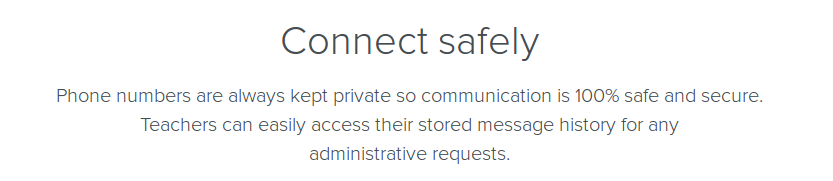
In their marketing materials, Remind highlights the safety of their service.

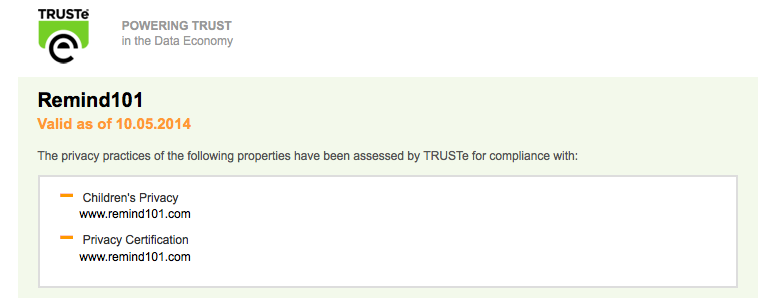
At the bottom of their privacy policy, they include a link to their Truste certification.

The Truste page defines how companies can get the Truste certification; I'm including the text here in full:

TRUSTe powers trust by ensuring businesses adhere to privacy best practices regarding the collection and use of personal information on their websites and apps. If you see the TRUSTe Certified Privacy Seal on a website or app, the company operating that property has met the comprehensive privacy certification requirements established by TRUSTe. The certification process helps ensure the business is transparent about what information they collect and how they use the information; the business provides you with control over what information they collect and how they use that information; and the business is accountable to the practices they outline in their privacy policy statement.

As we have seen from a very superficial look at Remind's privacy policies, Remind does not respect Do Not Track, and using the Remind service potentially exposes user data to another company (Twilio), with different policies, and they collect more data than is needed to deliver their service. If this is "transparent" or respecting user "control" and demonstrates "comprehensive privacy certification requirements" and "privacy best practices", I wonder what a company would need to do to not be eligible for the Truste certification.

We'll revisit this later in the post.

Remind Just Raised An Additional 40 Million!

On September 30th, Remind announced that they had raised an additional $40 million, bringing their total fundraising to $59 million.

As I mentioned earlier, Remind's policies are pretty standard for the tech industry in general, and edtech in particular. The fact that Remind's policies don't respect user choice didn't seem to have much of an impact on their funders.

Which begs the question: did Remind get VC funding because it improves teaching and learning, or did Remind get VC funding because some funders saw it as a good investment? When the context within which a company operates includes treating user information as an asset, the second option feels more likely.

Parent Sign Up Via Access Codes

When a teacher signs up for Remind, they are prompted to create a class. The entire purpose of Remind is for teachers to create a closed, safe space where they (teachers) can communicate openly with students and parents.

Remind marketing copy highlights the safety and privacy of their service. However, as shown in the video below, their signup process and recommended practice makes it impossible for teachers to guarantee the identity of the people signed up in their classes.

As noted in the video, when someone joins a class, they cannot see the full list of other members. Teachers have the ability to delete members from their class at any time. However, because teachers can't guarantee the identity of people in their class, the real potential exists for Remind classes to have lurkers who get included in full class messages. This runs the gamut from inconvenient to creepy to (in the case of a custody battle or stalking situation) potentially dangerous.

If the access codes used to join classes were tightly held, that would mitigate this risk, but Remind encourages people to share the codes via social media. This is shown in the video, starting at 4:30. In this specific case, the "privacy features" of Remind (where student and parent contact info is not shown to teachers) run headlong into Remind's recommended methods for distributing access codes. Given that Remind has a Teacher Advisory Board, I'm curious and surprised that this was missed. It seems difficult to reconcile claims of "100% safe and secure" with the limited ability of teachers to guarantee the identity of people in their class. I would love to see how a teacher with 4 classes of 30 kids apiece manages the identity of parent signups using only names.

Closing Thoughts

While this post focused specifically on Remind, the general practices described here are not uncommon. For example, just about every privacy policy makes the statement that user data won't be bought, sold, or shared, and then the policy goes on to define the conditions under which user data will be passed on through affiliate or partner arrangements.

In the specific case of Remind, several common elements come together: privacy policies and recommended practice that aren't effective, the Truste stamp of approval on these ineffective practices, and a VC funded reward of the entire system. When the privacy certification of an industry has more to do with "protecting brand" than defining privacy, we have a problem. It's patterns like this that lead to widespread, pervasive distrust of vendors in the education space. The disconnect between what vendors provide and what learners need is not helped by the well documented lack of diversity within the tech industry, and VC funded companies.

At the risk of being a Pollyanna, I don't think that any of this is done with bad intentions, but at a certain point the intentions cease to matter. It's possible to build useful edtech, respect users, and help people learn. Doing edtech right means that our privacy policies, terms of service, and funding mechanisms need to align. Current business models appear to set up a rigged game to benefit founders over learners; this approach is shortsighted and unnecessary (although very much in line with letting funders recoup their investment). We can build better edtech - complete with better policies - but it requires a different vision than what is currently in place.

, , ,

We Don't Need An App to Support Teacher Expertise

3 min read

While the goals of the American Federation of Teachers collaboration with Clever and ShareMyLesson remain unclear (to me, anyways), if the AFT or the National Education Association wants to increase the technological expertise of their members, they don't need an app for that. Between the 1.6 million members of the AFT, and the nearly 3 million NEA members, both organizations clearly have technological, pedagogical, and training expertise within their current membership.

If AFT and NEA want to support their members in becoming more effective at using online tools, rather than focusing on applications, why not shift the focus onto asking good questions - the types of open ended questions that drive learning, with or without technology?

Either AFT or NEA could pull a team of 100-300 technology and subject level experts from within their ranks in a heartbeat. If this group of educators was given financial support by their unions to work on creating trainings and documenting best practice for tech integration, OER authoring, privacy assessments, etc, they could have some solid material assembled over the course of a school year. If needed, unions could also pay for outside facilitators to help drive and direct the process - and over the course of the year, or perhaps as a year two follow up, some of the participants could also receive training as facilitators, so that they could support trainings for more members locally.

Using this process, at the end of one year, either AFT or NEA could have member-created materials documenting best practice for tech integration, open content use, privacy assessment, and other subjects as needed. These materials could be released under a Creative Commons license to support ongoing reuse and improvement at the local level.

At the end of year two, the documents created in year one could be revised and improved based on use and feedback. Additionally, union members could have received training as facilitators to help drive this process in other schools to support other union members.

This approach empowers union members with information and experience, and honors their expertise. It also provides a foundation upon which other members can build. It does not require any external vendor support, and because the emphasis is on skills first and specific technologies second, the material should be flexible enough to adapt as technology evolves.

As a final thought here, in reference specifically to one of the "benefits" of the collaboration with Clever - single sign on across multiple applications - it's still worth asking about the nature of the problem being solved. Remembering multiple logins is a real issue, but the question remains: is multiple logins the actual problem, or a symptom? In an EdTech ecosystem trained to see learning delivered via apps, the "answer" to most any problem will be a technology. But, if the technology has proliferated to the point where a class can't function due to too many logins, the problem might be bad planning and poor pedagogy. Single sign on won't solve that.

, , , ,

What Problems Get Solved by the AFT, Clever, and ShareMyLesson Collaboration?

5 min read

On Friday, Benjamin Herold wrote a piece where he outlined the new collaboration between ShareMyLesson and Clever, and how the American Federation of Teachers is backing this collaboration. His piece also stated that connections with Clever could support OER creators. There were a few elements that seemed off in both the deal, and in how it was being described. This piece looks at Clever, ShareMyLesson, and OER, and breaks down some of the implications of the collaboration.

Clever

Clever collects data. Clever specifies ways in which they can share data. Clever can change terms of service at any point, with no notice, meaning that the terms you agree to today might not be the terms you operate under tomorrow. Also, given that the purpose of Clever's Unified Login is to streamline access to other apps, Clever creates a web of connections between different apps, and it is almost certain that each application has its own privacy policy and terms of service. So, even though Clever's terms of service and privacy policies are less than ideal, users of Clever will be shuttled between apps with different terms of service. It's unclear what notice, if any, end users have when they are shifting into activities governed under a different privacy policy. It's comparable to apps on Facebook, where user data is protected largely at the discretion of the individual app developers.

It's also worth noting that many aspects of Clever are very similar to inBloom, particularly in streamlining data that is pushed to student information systems. This EdSurge article from August, 2014, closes with the same conclusion:

“On Clever, when you have students working on half a dozen apps on engagement and performance, the teacher has to login to each to see how the students are doing on each individual app,” Krull notes. “At this point, the next step after customizing the platform for teachers and students is, how can the data from each app come back to a reporting panel?”

Bet that's something we'll see more clever solutions for soon.

Clever's marketing department deserves a lot of credit for avoiding the same notice and backlash experienced by inBloom.

ShareMyLesson

The terms of ShareMyLesson have been baffling for a long time. I've gone into this in the past, and don't have much new to add now except to note that the terms haven't improved at all. It's also worth highlighting that ShareMyLesson could mitigate many of the more obvious problems just by adding licensing options to the screens where members share resources. But currently, ShareMyLesson collects data on end users, claims control over user content and data, and their terms prohibit even basic reuse of content. There is a direct disconnect between the "pledge" on ShareMyLesson, and their terms.

OER

OER doesn't need single sign on to succeed. Lack of access to OER isn't the issue, and OER adoption has been on the rise in recent years for a range of (largely human/organizational, non-technical) reasons. Barriers to OER adoption include widespread use of formats that aren't open or reusable, and misunderstanding around the rights granted via open licensing. In short, when we work with OER, train people on how to use OER, and build systems that support increased use and creation of OER, the barriers are largely human, and not technical.

If AFT had just partnered with CK12, they could have connected with a pre-existing OER community and organization, with a track record in K12, and a large body of resources that are licensed for reuse and increasingly Common Core aligned. AFT could have avoided the privacy issues of Clever, the privacy and licensing issues of ShareMyLesson, and could have gotten down to the business at hand: supporting their members as they teach.

Conclusions and Next Steps

However, both Clever and ShareMyLesson will get some immediate benefits.

Both Clever and ShareMyLesson will get another 1.6 million users. Note, these aren't active users, but in VC-funded EdTech land, the size of your member base is an easy metric to show funders your "value." And, while ShareMyLesson isn't VC funded (to the best of my knowledge - please correct me if I'm wrong), getting another 1.6 million users provides justification and cover for any expense incurred in developing either the site or its resources. Additionally, the increased userbase and corresponding collection of user data makes ShareMyLesson more attractive to any potential buyers. And yes, according to the SML privacy policy user data gets transferred in a sale.

In addition, the AFT is doing some stellar marketing and outreach for Clever. I hope that Clever is paying the AFT a large sum to compensate AFT for marketing directly to teachers and schools on their behalf.

If I was a member of AFT, I'd have a lot of questions about this deal, but I'd start with these five:

  1. Has any of my personal information been shared with either Clever or ShareMyLesson? If yes, what information has been shared, and why? NOTE: I'm assuming that the answer to this question is "no", but it bears asking.
  2. What are the financial details of this arrangement? Is AFT getting paid by Clever, is Clever getting paid by AFT, and/or is there any outside funding helping to subsidize this work?
  3. What data is collected on me by Clever, and by the different applications that Clever integrates?
  4. How can I review, modify, and delete the data collected on my by the Clever, ShareMyLesson, and other applications integrated via Clever? If there is no way for me to do this, how will AFT leadership guarantee the safety of my personal information, and of my site usage information for all apps accessed through Clever?
  5. Why is AFT leadership pushing and championing use of ShareMyLesson, a site that claims control over my work, and claims that my personal information is a business asset?

The responses to these five questions would shape any follow up.

, , , , ,

Triaging Privacy Policies and Terms of Service

5 min read

Reading Privacy Policies and Terms of Service can be a mind numbing task, but the process of reviewing how an organization describes basic relationships with people can tell you a lot about how the company works, and the company culture. In this post, I will use "privacy policy" and "terms of service" interchangeably. When I use either term, I mean, "the combined policies that describe the rules for using a site, and how the owner of the site can treat you."

If you want a quick primer on policy and practice before reading privacy policies, two useful resources are https://tosdr.org and the opening section (titled "Statutory Framework") of the Fordham CLIP study (pdf) on privacy and cloud computing. TOS;DR or Terms of Service; Didn't Read gives a great overview of the structure of privacy policies used by tech companies. The opening section of the Fordham study covers the three main federal laws guiding privacy: FERPA, COPPA, and the Protection of Pupil Rights Amendment, or PPRA.

There are countless other sources of information out there, but these two provide concise, accessible, and accurate information.

There is no way to evaluate a privacy policy well without taking a deep dive, and reading the whole thing. However, prior to doing that, you can get a sense of how things will go by looking for some traits that are common among privacy policies. In the video, I'll use these basic starting points to do a quick triage of Edmodo's privacy policy and terms of service.

Because the terms of service are so incredibly text heavy, a triage requires liberal use of your browser's search feature (usually accessed by hitting "control-f"; in Firefox and Chrome this option is under the "Edit" menu). When I'm triaging policies, I navigate to the privacy policies and terms of service and start with the following elements:

  • How are terms changed? - opt in to new changes? User review/feedback of new changes? Can they change terms at their discretion, with no notice if needed? Search terms: change, changes to, notice, notification
  • Business transfers - is user information something that can be transferred in case of bankruptcy or sale, adn what rights do you have to opt out? Search terms: Business transfer, acquire, transfer, bankrupt
  • How do they define "Personal Information" and/or "Children's Personal Information"? Search terms: personal information, childrens personal information
  • Use of 3rd party services/partners/affiliates, and the policies of these partners. Search terms: service, partner, affiliate, share
  • As a user, do you give up rights to your data? Does the site claim any rights to reuse? Can you license your work how you want? Search terms: intellectual property, user submission, user content, copyright
  • How is data used? Because this is the core of what privacy policies attempt to define or, arguably, what they attemot to obscure - you will need to cross reference different sections of the privacy policy and terms of service. Don't be surprised to find contradictory sections here, and when you do, assume that the least advantageous clause will win the day. Search terms: usage, aggregate, identifiable
  • How do they describe cookies and tracking? Important information to look for includes how they store Location, Device information, Device ID, and/or Operating system. Search terms: Device ID, Device user, Location, Mobile, cookie, beacon, gif, identifier
  • Data portability/exports - can you get your information out in a usable format? Don't be surprised if you get nothing back here. If they have anything, information about data portability is usually included in proximity to account cancellation. Search terms: download, export, portable, portability
  • Deletion/Account cancellation - how easy is it to leave their service, and have your information deleted? Search terms: cancel, delete, viewable, visible
  • General discovery: FERPA and COPPA search. For this, use Google's site search feature: FERPA site:sitename.com. So, searching Edmodo for FERPA looks like this: ferpa site:edmodo.com. Searching a full site often brings up documents that explain policies, and it's essential to compare these talking point docs to the actual policies. Disconnects can exist between a company's intent, and their actual policies; when these disconnects occur, we need to remember that the policy - not the intent - is the legal document.

Once the policy has been triaged in an initial review, we can look for contradictory clauses in the terms - this is usually the starting point for a more detailed analysis, but it can also be part of a good triage.

As I said earlier, when reviewing terms of service, there is no substitute for reading and re-reading the terms. They are legal documents, and while they define how people can use a service, it's important to remember that the terms were created by the professionally argumentative class: lawyers. The task of the rest of us non-lawyers is to analyze how these terms impact us, and whether any risks or impacts seem fair, necessary, or acceptable.

UPDATE: Stephen Mutkoski flagged that the use of the word "may" is also useful to track. My suggestion here: substitute "will" for "may" and see how it reads. If a vendor says that they *may* do something, it means that they have the right to do it, so we need to assume that they will.

For example, Edmodo's privacy policy states, "Our partners, affiliates, and service providers may also transmit cookies to your computer..." - if we substitute *will*, the statement is more accurate about the potential of what could, over time, happen: "Our partners, affiliates, and service providers will also transmit cookies to your computer..." END UPDATE

,