Follow Up Thoughts On inBloom Panel at Privacy Academy and CSA Congress 2014

9 min read

A few weeks back I was part of a panel discussion on lessons learned from inBloom with Virginia Bartlett (who was CPO for inBloom) and Omer Tene.

Jedidiah Bracy has a writeup on the session that is pretty solid; this piece adds in some details and expands on some thoughts that might have fallen through the cracks during the panel. While the conversation covered a lot of ground, we only had an hour, which is barely enough time to scratch the surface.

Here are some of the details that were touched on in the conversation, with some additional comments. This list is by no means complete, but these are some of the thoughts I've been coming back to since the panel.

inBloom Was A New Vendor In A Well Established Niche

A short list of other companies in the space include eScholar, Pearson SchoolNet, Infinite Campus, Agilex, and Clever. Many of these companies - with Clever being the one that is generating both the most buzz and the least critical scrutiny - support sharing data with other vendors, under a range of terms of service and privacy policies. Any of these vendors have almost certainly moved more data in the last month than inBloom ever did, under terms that are at best opaque.

All states have (and have had, for over a decade in most cases) detailed requirements around data collection. The Federal government has detailed requirements for states as well.

Much of the data collected at the state level is driven by the need for federal accountability reporting. Increasingly, though, vendors are looking to access student data to power various applications. The privacy concerns with both data collection by government for accountability reporting, and data collection by vendors to support learning applications, are longstanding, and predate inBloom. Additionally, these concerns continue to exist after inBloom's demise.

The Role (and Potential) of an Open Source Option

In this current landscape, with a small number of players at the district, regional, state, and federal level, data storage and collection is a zero sum game. All of the major options are vendor driven.

inBloom had an open source option. The code was freely available on Github. In practical terms, this meant that a district, regional provider, or state could access the code and run the software wherever they wanted, without ever interacting with any external vendors.

inBloom the organization did a poor job managing the open source component of the project. If they had prioritized and publicized that an open source version - that could be freely installed, and privately managed - was a central part of their vision, they could have avoided the charge and perception that they wanted to be central to the flow of student data.

More importantly, if they had been more active documenting and visibly supporting a freely available open source option, it would have given districts a real alternative to high priced, vendor-supplied alternatives.

Errata/Clarifications

In Jedidiah Bracy's writeup there are a couple minor points I want to clarify.

Gates, Murdoch, and Klein

In the panel, I talked about how perception of inBloom suffered - initially in New York, and eventually nationwide - due to connections between Rupert Murdoch, Joel Klein, and Bill Gates. Joel Klein was an unpopular and polarizing NYC Schools Chancellor who was hired by Rupert Murdoch. Some of the development work for inBloom was done by Wireless Generation, that rebranded as Amplify Learning. Given Joel Klein's polarizing presence, a Murdoch-owned subsidiary doing development work on a privacy related application in the wake of the phone hacking scandal, and the Gates foundation funding connection to the increasingly unpopular Common Core rollout, there was a little something here to make just about anyone unhappy.

inBloom Was Not Too Transparent

They started down the road to transparency, and then stopped. The information they provided made sense to people in the space, but they failed to make the technical aspects of the project comprehensible to people who don't read data specs as part of their regular life. Following through on documentation would have helped mitigate this.

They also made the mistake of not providing any context or background about the rationale behind many of their choices. For example, inBloom implemented the EdFi data spec, and one of the things that inBloom actually did well was to make the EdFi spec accessible. But, they never talked about how the EdFi spec is highly similar to the CEDS spec, and how the CEDS spec relates to the SIF standard. As a result, people saw this incredibly long list of data points and attributed them to inBloom's creation, when the reality was that inBloom actually just documented pre-existing data specs in a way that made them more readable.

This is one of many examples where inBloom's silence and lack of engagement was a horrible miscue. inBloom was definitely not too transparent. If they had shown up and discussed - as just one of many examples - the difference between what is supported by a data spec and what is required to be used in a data spec - they could have increased their transparency and actually contributed to the larger privacy conversation.

On The Awkward And Humorous Position Of Being Labelled

Since I started writing on inBloom I have been labelled by many people in the discussions. Interestingly, people with a industry slant have told me that I am too biased against industry, where people with an anti-inBloom slant have criticized me for not being adequately strident about inBloom, and for repeating industry talking points.

And I listen and laugh, mostly, although I will admit it gets old, in both directions.

But I figured that it'd be fun to attempt to clarify, so here goes:

I'm pro-kid, pro-parent, pro-teacher, pro-school, pretty much in that order. I'm strongly pro-privacy, and believe that just about every step in the chain - including student and parent understanding of data collection, teacher understanding of data collection, school/district understanding of data collection, contracts with vendors around tech services, local and state level data collection practices, vendor terms of service and privacy policies, and state and federal laws around privacy - is inadequate, in different and sometimes contradictory ways. I view privacy through the lens of social justice. I'm not a huge fan of data collection and use with kids, as the hype has far outstripped the actual uses, and I see way too many VC funded companies starting services that grab more data than they need with inadequate concern for student privacy. At best, it's sloppy and at worst, it's predatory.

I'm also fine with being wrong - it happens multiple times a day - and accordingly, I'm always glad to listen to differing viewpoints. As a result, I've been able to talk with a range of people. And, just because I talk with a lot of people doesn't mean I agree with them - while I do my best to listen, I will also confess to having my opinions, and on occasion being pretty stubborn about them.

This context has informed my take on inBloom. I never saw them as more than a well funded new player in an already crowded field. And with that said, over the course of writing about inBloom, I was more than a little shocked at the binary view that appeared to be required in the conversation: you either despised inBloom and, by extension, everything Gates-funded, or you were a mouthpiece for The Man and wanted all children hooked up to full body sensors while they watched Khan Academy videos. I don't think I fit neatly into either of those spaces, although there has been no shortage of people telling me otherwise, in both directions.

inBloom, like many companies, did some things right and some things very, very wrong. The attempted rollout in New York state provides some amazing examples of how not to do state level rollouts, but if there is a need to parse out blame, the top-down approach of NYSED paired with the silence from inBloom about their actual role provide some good starting points.

In many ways, I see the popularity and growth of a company like Facebook as the flipside of the inBloom experience in NY. If Facebook had been a government project, it would have failed miserably.

But, more than anything else, I'd love to see EVERY company moving student data get comparable scrutiny to what inBloom received. Eliminating a single vendor from the field doesn't move us closer to addressing the underlying issues of policy, contracting, and practice within schools and districts.

But We're Still Not Talking About Learners

And, with all this conversation about privacy, we are still missing the point. Our current models of data collection, and discussions of data privacy, all position learners as observed objects rather than active, informed agents. Within the current frame, data collection, like education, is something that happens to a learner - as opposed to something that the learner drives, shapes, and informs. Our conversations about data privacy have the same flaws as some of our conversations about what learning should be.

The privacy landscape and the educational landscape would look very different if we incorporated learner (or parent) control as a requirement at the outset. If school-level data systems included means for learners to review, challenge, add to, modify, or delete elements of their learning trail, privacy looks different. If educational records took the shape of a learner-controlled portfolio - and any app used within a school needed to be accessible - FERPA rights take on actual meaning.

But these details are completely ignored in much of the privacy conversation. Privacy - or lack thereof - is something given to or taken from learners. In this context, any connection between learner data and actual learning is incidental.

If, however, we ground our discussions on privacy in the absolute and unquestioned need for immediate student and parent access, we shift the privacy conversation. We also gain a clearer understanding of the actual point of learning.

, ,

Questions To Ask Your School Or District About Privacy

3 min read

These questions are a starting point in getting a sense of how your school or district understands and responds to issues of student privacy.

Also, in looking at privacy and data storage, it will likely become necessary to differentiate between data that is considered an "educational record" and data that is not considered an educational record. The definition of educational records is part of FERPA. Under FERPA, parents also have rights to review and challenge data that is collected and stored as part of an educational record.

Other data will likely be covered under district policy and/or a vendor terms of service.

With that said, here are some questions to jumpstart the conversation:

  • Ask for a list of vendors who get educational records covered under FERPA.
  • Ask for a list of vendors who get student data that is not considered an educational record.
  • Ask to see executed legally binding contracts between the school (or district) and the vendor. These agreements should include terms of service and privacy policies. The terms of service and/or privacy policies should specify parental rights to review and/or delete records on vendor systems. Needless to say, if the district can't produce a contract, that's a bad sign.
  • Ask how a parent can opt out of having student data that is not an educational record stored on a vendor's system.
  • Ask to descriptions of the datasets collected by and stored in services used by the school. This should include the schoolwide student information system, to learning apps used in your child's classroom.
  • Ask the school or district to verify that any list of services storing student data includes any apps used as part of an iPad or Chromebook program.

It's also worth noting that teachers should ask these same questions, and include questions about what apps store information on teachers.

In fairness, these questions should probably be directed to the district, as getting answers to these questions will require a significant amount of time, and it's probably better for kids in school to have district staff time used to gather this information than teacher or school staff time. And, while I hesitate to descend into cynicism, do not be surprised if districts stonewall, or have no idea how to answer these questions. This should be the beginning of a conversation where they begin to understand the need for them to become more organized and focused on how they manage student privacy needs, and parent outreach.

, , ,

As Long As We Have Bias, We Need Data - And That's A Privacy Issue

2 min read

Bias in schools manifests itself in various ways, ranging from the school to prison pipeline, disparate discipline based on race starting in preschool, to corporal punishment applied to students of color, to higher diagnoses of learning differences based on race, to teachers showing stunning disrespect toward their students and communities.

Data captures these trends. Reliable data collection paired with sound data analysis is one way to ensure that these stories - these realities - are not erased from our collective memories.

In some privacy circles, there is pushback against storing things like discipline data and learning difference data because there is concern that, if this leaks out later in a person's life, it could be used against them in a way that would put them at a disadvantage. However, without accurate data that tracks trends over time, quantifying the impacts of bias - and how bias plays out along racial lines, and how bias has a direct and negative feedback on the lives of students - becomes impossible. Reliable data, and sound analysis of that data, is indispensable in identifying problems related to equity, addressing those problems, and assessing whether any interventions actually work.

To put it another way: one parent's concern about the potential damage that could be caused by an as-yet unrealized data leak is another parent's proof of racial bias in their child's life. When I see privacy advocacy from groups that are anti-immigrant, anti-voting rights, anti-lgbtq, anti-women, anti-science, I see efforts to reduce the efficacy of sound data use to identify and address real and pressing issues of prejudice and bias.

This aspect of the privacy debate is rarely discussed. Many of the current conversations of data only address one facet at a time. One of the contexts that privacy advocates need to address and embrace is that bias within schools is real and ongoing, and that accurate data helps us understand - and hopefully address - these issues. Privacy advocacy that ignores entrenched bias - and downplays the role of data to address that bias - will remain ineffective and incomplete.

, ,

Follow Up Thoughts on ClassDojo Terms of Service

19 min read

Update, 08 October 2015: Since this post was written, I have had the opportunity to talk with people within ClassDojo. In these conversations, we candidly discussed the issues raised in this post. The team within ClassDojo listened, and incorporated this feedback while they updated their policies. In short, they were responsive to constructive criticism, and improved their terms. I would love to see other companies follow their example. End update

A couple weeks back, I put out a post on the Terms of Service and Privacy Policy of ClassDojo. For background context to this post, please read the comment thread in response to the original. One of the commenters was Sam Chaudhary, the co-founder of ClassDojo. He made some excellent points in his comment, and I wanted to be sure to respond. Toward that end, and toward not having the dialogue get lost in the comment threads, I pulled this response into a new post. Sam's comments are included as quoted text, and my responses follow.


Bill, hey! This is Sam, co-founder of ClassDojo. Thank you for such a thoughtful post and some excellent feedback; I wanted to chime in with a few thoughts - all of us in education are trying to do the best we can for students, and that is good common ground to start from!

Hello, Sam - Thank you for contributing here. I appreciate you making the time, and your thoughtful feedback. I have some additional thoughts and questions, which I include inline below.


I’ve said this before publicly, but it’s worth being clear about it: ClassDojo does not now, and will never, sell or rent users’ personal information to anyone - especially marketers and advertisers. I was a teacher, and I feel strongly about this - so I insisted we state this clearly in our privacy policy: “we are not in the business of renting or selling your Personal Information or Children's Personal Information to anyone”. We take a lot of pride in doing what’s right by our teachers, parents and students, and all our operating practices reflect our belief in doing just that.

I hear what you are saying here. If your policies stopped here, and didn't include additional language around partnerships, what you have in place here would be pretty solid. But, as I will discuss below, there are places where individual policy provisions appear to be contradictory, and your stated policies drift from your stated intent.


Your post makes some excellent points, very thoughtfully: in the same spirit, I wanted to clarify and provide more detail on how we’re thinking about or addressing these. For what it’s worth, it feels like we’re very aligned on a ‘user-centric’ approach to privacy in how we operate - and I totally agree that some of the ‘legalese’ in our terms / privacy policy could be clarified to reflect that approach.

Somewhere, somehow, there has to be a balance between the legalese and the human-readable version. Toward that end, I like the format used by 500px, with the terms in one column and a human readable summary dsiplayed alongside the terms.


1. Communicating about ‘specials’: the intention here was for ‘specials’ to mean one-off special features, materials, events or offers. An example would be, for example, the ‘back-to-school night’ guide (www.classdojo.com/backtoschoolnight) we recently created for teachers - it’s not a ‘new feature’, but is a special guide for a one-off event. I agree this could be clearer, so we will get this clarified!

If you specified that a "special" was just an event announcement, and differentiated that from any sales pitch related emails, that would help clarify the purpose here. This could also be augmented (or possibly even rendered unnecessary) if you allowed teachers to opt-in to specific types of announcements. Categories could include "Let me know about new features", "Let me know about offers from partners", etc. By making it opt-in and then clarifying the types of announcements you might send, you would make this more transparent. Then, this section could be modified to let teachers know that they can set these options in their account settings.

If this is already an option for teachers in their account settings, please ignore this. I created a demo teacher account, and did not see any options for controlling emails in the profile settings, but it's possible I missed it.

And, at the risk of stating the obvious, marketing to teachers students and parents shouldn't happen, and the terms should specify that here.


2. Students’ under 13 sharing information: to clarify: we do not allow students to share personal information with us (and we don’t ask for it, except for legal reasons - such as discovering that students are under 13 in the first place!), even after they have signed up.

This is one of those areas where the blind spots of COPPA become more apparent. If you have a class of second graders, you will be getting information about students under 13. This will largely be from teachers, so it will be information shared *about* U13s instead of information shared *by* them, which falls more outside of COPPA and under FERPA, provided the information shared is an educational record. But, given that the data stored on your site is arguably more of an observation than an educational record, it's not clear if FERPA even applies (and I'm not a lawyer, and would love to hear an informed legal opinion on this).

Having a policy of only using initials for last names for under 13s (arbitrarily determined by grade level of the class) would be a decent balance point. I think that clarifying the language around responding to COPPA issues, and clarifying exactly what "delete" means in all contexts would mitigate this.

And with that said, COPPA compliance is tricky. While schools are generally in the best spot to triage this, they are also more likely to not understand their obligations, which puts service providers in a tricky place. But both COPPA and FERPA are pretty out of date, which really doesn't help things.


3. Combining teacher information with other lists: when teachers join ClassDojo, they have the option of joining their school. Teachers are now able to easily collaborate with each other using ClassDojo, but in order to create this safe environment, we needed to ensure we had a list of real schools - and this sentence basically covers us matching the school a teacher enters with a list of all schools in the US. I agree the language sounds scary when it’s not intended to be - we will clarify this in the next update.

Your current language is pretty broad, and allows combining data from almost any source. If you are only going to combine teacher data against a school list, you should say that, but your current terms don't place many limits on data sources used in recombination. I'm glad to hear that you will be cleaning this language up, as your current policies allow behavior that is far more broad that your stated intent.


4. Others who may sell items / provide services to you with ClassDojo: if you use ClassDojo you’ll know that we don’t sell anything from third parties - and, as I’ve mentioned, we will never sell or rent information to advertisers to sell things to you. This sentence is merely intended to allow us to one day work with other parties to provide a more complete package of services to teachers, parents and students; an example would be giving teachers videos or guides on ‘how to build persistence’. We don’t do that currently, but if we ever did, as stated, we will not share personal information beyond what is necessary to provide those services, and we’ll make it abundantly clear when services are being offered with a partner, with clear options to opt-out. Again, the spirit is right but I agree the language can be clarified, and it appears there is a sentence conflict that should be resolved - we will update it in the next version.

This is where things really drift. Starting with the easy part: additional services should be opt-in, not opt-out. Your users should have the option to choose whether or not they find a new service valuable or not.

But where it gets very fuzzy is with this line: "We don’t do that currently, but if we ever did, as stated, we will not share personal information beyond what is necessary to provide those services" - earlier, you say that ClassDojo "will never, sell or rent users’ personal information to anyone". But, in this section, you describe a potential partnership where data would be transferred as needed to fulfill the needs of a business transaction. From the perspective of an end user, it doesn't really matter if their data is transferred as part of an outright sale, or if their data is transferred as a required element of a business arrangement: when the dust settles, their data has been shared with a third party.

My point here: what matters is that, under specific conditions, ClassDojo terms allow an unspecified portion of user data to be transferred to 3rd parties. Given that you describe an opt-out system, the data could be transferred without explicit user consent. Your terms should be explicit about that. The conflicting language ("we will never sell data to anyone" versus "we can share data as needed to facilitate partnerships") is confusing, and in the end doesn't prevent user data from being moved to a 3rd party.


5. Business transfers - I’m afraid in this case the interpretation might be a little off. This term does not refer to ‘selling on information’ whenever we want to as a business asset; it largely covers the case of ClassDojo ever being acquired, or going bankrupt, both of which are legal outcomes our lawyers need us to be explicit about. If either of those ever happens, again, we will continue to do right by our users: our position will continue to be to never sell on or rent information to marketers or advertisers in either of those cases, or do other sleazy things with user information. You are right that this could be misinterpreted, though - I will attempt to clarify this in the next iteration.

If ClassDojo specified that users would have a 30-60 day window to deactivate their account, and have all their data deleted before a sale or bankruptcy proceeding, this section would be much more user friendly. As it currently reads, user data becomes an asset that is included with the sale. While I hear you - loud and clear - that your intent is sound, your ability to control what happens to transferred data becomes pretty negligible in either a sale or a bankruptcy.

An improvement here would include these components:

a. Users will be notified in the case of a sale, and will have X days to export and/or delete their accounts and all associated data; b. Define the means by which users will be notified of a sale or bankruptcy; c. Define that the data that is transferred to a new owner will not include legacy backups that contain user data that might have otherwise been deleted.


6. Deleting information fully - I believe we’re on the same page here, but the wording may be confusing and I’d like to improve that. To clarify, we delete a user’s profile fully and completely from our databases when requested. Some remnant information may still exist - a good example being a student report downloaded by a parent, and of course we cannot delete something that has been downloaded! We’ll absolutely clarify this language, however, so that users are aware they can delete their account fully.

That's awesome. I'm assuming that the parent account has a "Delete My Account and My Child's Account" option? I don't know, because I haven't seen the parent UI, but making the account cancellation process as frictionless as possible is a user-friendly implementation. I did not see any mechanism for teachers to delete their account. I'm assuming that this is because there is more data associated with teacher accounts, and you are attempting to protect teachers from destructive data loss due to user error. But with that said, teachers could be protected against user error via confirmation/splash screens. It's 2014, and the UX of doing that well is not new ground.

What you say about downloads makes perfect sense :)


7. Deleting information fully for COPPA-compliance - as above, we delete information fully, so we’re on the same page here.

Awesome. Thanks for clarifying.


8. Updating terms - we make it clear that we will send you a notice via email or post notices on the website. I believe this is pretty common practice, but I’d love to hear other methods of making updates more explicit.

Big +1 on the email and notice approach. Combining this with an explicit acceptance of the new terms would be a great approach. The notice on the site and the email could both contain links for parents/teachers to review and accept the updated terms of service.

However, this is in direct contradiction to the language in the second line of your terms of service. The line reads, "By visiting the websites or using the services in any manner, you agree that you have read and agree to be bound by and a party to the terms and conditions of this agreement without modification to the exclusion of all other terms."

As this line reads, it appears to state that if anyone visits any page on the site, they implicitly agree to the terms. Given that this line is the second line of the terms of service, it's both absurd and confusing to make a claim that visiting a page constitutes agreement.

I suspect that what happened here is that your terms have evolved over several iterations, with specific sections being added without a comprehensive review of the entire document. This is not abnormal for companies that are growing rapidly, but contradictions like this make it very difficult to get a clear sense of rights conferred or removed by the terms.


9. Registration language for under-13s: totally agree; it is tough to direct 10 year olds to this - however, this is why we have a COPPA-compliant signup flow, as certified by Truste. We stream users into teachers, parents and students, and make every effort to stop under-13s signing up as anything except students.

Yeah - COPPA compliance is always going to be tricky. I'm less concerned about a Truste verification than I am about making sure that schools understand their obligations here. As I mentioned earlier, schools are in the best position to do COPPA reviews, but often don't fully understand their obligations. In that case, vendors have a role to play to educate them, but staffing for that when you are offering a free service is a time consuming and expensive proposition.


10. FERPA: we don’t share parent or student information without their explicit consent; it’s as simple as that. FERPA applies to educational institutions, and we help them fulfill their obligations by giving students and parents access to their own information whenever they want it (through parent / student accounts), and not sharing parent or student information, except in accordance with FERPA. I do agree that this section could be clarified - I’ll work on getting some clearer language here.

Yeah, FERPA is another can of worms. Is it possible for a parent to review all of the data you have collected on their kid? I'm assuming that at the very least they can see the behavioral information on their student. But this is also an odd corner of FERPA - a lot of what you collect would arguably not be an educational record, and given that FERPA (in its current form) is more of a funding bill with privacy implications than an actual privacy bill, what would your obligations be under FERPA if a business transaction would benefit from the behavioral data of students?

Let's say that you had a hypothetical deal with a video provider that would offer parents videos based on the student behavior reports. Would FERPA prevent/hinder sharing of student behavioral data with a 3rd party video provider? At the risk of stating the obvious, this is a question for the lawyers, and I suspect that even among the lawyers the answer will be a resounding "maybe."

This is another area where a delete button for parents would support parental rights under FERPA. Parents should have the right to opt their child into or out of a 3rd party service that takes data on their child.


11. Free and paid services: the ‘paid-for’ features mentioned here refer to new features we may develop in the future, that we might charge for - NOT charging for current features or locking-up users’ data. As I have said before, we never sell on or rent information to marketers or advertisers, and will certainly not charge users for access to their own data: they can get it any time in their account, and can have it in other forms at any time by by emailing us at hello@classdojo.com! I can clarify this in the next iteration of this policy.

That clarification would be great. Does ClassDojo support (or plan on supporting) any kind of export API? And, when a parent requests their kid's data, in what format is it delivered?


12. Class action language: I agree that this section seems very legalistic. Our lawyers say it is a standard legal term; frankly, it doesn’t seem material to how we operate every day as a company, but the lawyers insisted on having it in as it is apparently a standard requirement. I do see that many other companies used extensively in education have similar terms in their policies, such as Dropbox (https://www.dropbox.com/privacy#terms) and MineCraftEDU (http://minecraftedu.com/licensing).

Since reading your comment I went on a hunt for this language in other policies, and it pops up with some frequency both in and out of edu. I've been thinking about this a bit more, and I think I'm coming around to agree with the lawyers. It's a decent protection against frivolous lawsuits. Having human-friendly language here (something like "We're not concerned about any class action lawsuits, but we also know that people do silly and unpredictbale things, and this language gives us some limited protection against this") would be helpful.

Which is a long way of saying - I agree with you on this.


Bill - I hope some of these thoughts help clarify the intent behind the terms and privacy policy. ClassDojo is always evolving and improving, on every front, and your feedback helps us greatly. Our mission is to help teachers, parents & students develop through positive feedback; we’re trying to help students learn the behaviors and skills important to lifelong success by enabling teachers and parents to recognize and encourage those. In order to achieve this, our terms needs to be clear so that teachers, parents and students can all participate with confidence.
I appreciate the spirit of open collaboration and feedback, and I hope this discussion will help us further reflect our operating practices and intentions in legal language. As I mentioned before, our approach to privacy has always been to do what is right by our teachers, parents and students; while legal language can certainly sound scarier than those intentions, this feedback will help us work towards clearer, crisper language.
We’d love further feedback from you (or others on the thread!) as we further clarify our terms and conditions - getting them crystal clear is a top priority for us. Please email me anytime at sam@classdojo.com if there’s anything I can do to help, or if you’d like to discuss further. Thank you once again for the feedback: I’m hoping this can be a model for how all of us trying to do good things in education can work together to make sure we continue to do right by the teachers, students and parents we work with, and care so much about.

I hope that my feedback here has been helpful. For what it's worth (and as is probably obvious) I actually enjoy reading privacy policies. A lot of the issues I described with ClassDojo policies are also present in many other policies. In the fairly near future, time permitting, I'll be putting together a checklist of items for parent, teachers, and district staff to review when they are evaluating services. This conversation has been very helpful for distilling some of these items.

, , , ,

Kids Deserve Safe and Respectful Learning Environments

1 min read

This year, in the wake of the murder of Eric Garner at the hands of NY City police, in the aftermath of the shooting death of Michael Brown by a police officer, in a city where "policing" has meant stop and frisk based on racial profiling, a group of New York City teachers chose to open the school year wearing NYPD t-shirts.

This petition has some great suggestions on how to move forward constructively.

Go sign it.

,

Using ClassDojo Data To Spot And Correct Bias

3 min read

According to the ClassDojo home page, over 35 million teachers, students, and parents now use ClassDojo. That's a lot of data, and we should be mindful about the ways in which the rights to the that data are assigned.

The goals of ClassDojo - also as stated on their home page - are to:

Improve behavior

Improve specific student behaviors and engagement by awarding and recording real-time feedback.

Share data

Print or email beautiful behavior reports to easily engage parents and staff.

Save time

Save time by recording behaviors and accomplishments right in class, with just one click: NO extra data entry required.

However, while teachers are recording data on students, and at times using that data to create behavior walls for public display in their classroom, the app is also capturing huge amounts of data about teacher behavior. What students get rewarded? For what do students get rewarded? Are students in a particular class more likely to get penalized for behavior during a specific classroom activity? Are students more likely to be penalized for behavior during a specific time of day? Do boys get rewarded or penalized more than girls? Is there any variability across gender or race based on subject? What patterns exist among teacher communication to parents?

From what I understand, ClassDojo doesn't specifically collect information on race, but because data analysis works, some of these details can be inferred with general accuracy over a data set. If ClassDojo worked with school districts within FERPA to get this data back to schools and teachers, they could be close to 100% accurate around demographic details.

If ClassDojo chose to, they could give incredibly valuable feedback to teachers. Their data could demonstrate if teachers showed bias in how they gave feedback in multiple ways. Given the size of their data set, they could probably detect patterns of bias - or lack of bias - within schools and districts. This would be incredibly valuable information for teachers, schools, and districts to have as they planned ongoing teacher professional development, and would also help get models of more successful school cultures. This would also be incredibly valuable for parents to know when they were working with teachers: if a teacher has a track record of bias, a parent has a right to know, and ClassDojo's dataset almost certainly has the components to analyze this.

Of course, it's highly unlikely that ClassDojo would ever reveal this information, as their business model is predicated on marketing to teachers. If ClassDojo were to turn around and hold up a mirror that reflected an unflattering picture, it would not go over well. But, the data is almost certainly there - teachers have given it to ClassDojo with every mouse click and behavioral record entered.

And, nothing in the ClassDojo terms of service prohibits this type of analysis or use. As I said earlier, if ClassDojo offered this type of analysis as a service, it would be incredibly valuable. Teachers could use the data they entered to spot when their lessons fall flat, if there are specific times of day where they have difficulty with their class, and/or if they have different responses based on race and gender.

, , , ,

Racism, Bias, and Teacher Accountability

2 min read

When I see a group of white teachers, largely female, posing and smiling in their NYPD t-shirts, it gives me pause.

Not because their union told them not to, but because it shows an incredible degree of cluelessness and disregard for the students they are supposed to be serving.

According to the NY Post the photo above shows teachers at PS 220 in Queens. By my count, there are 20 people in the photo. I was curious about the demographics of the school where this picture was taken, so I went to NCES where you can look these things up. The exported dataset I used for this post is attached.

In 2011-2012, this school had 41 teaching FTE allocated to the school. We can safely estimate that these 41 FTE were split among approximately 50 adults, as schools commonly have part time FTE positions. Using these numbers, it's possible that the adults in the photo shared above represent between 1/3 to 1/2 of the school's teaching staff.

Looking at the school demographics, in 2011-2012, PS 220 was a schoolwide Title I school. The school enrolled 609 students, preK through 5th grade. According to NCES Data, of those 609 students, 58 are black, and 154 are Hispanic, which means that over a third of the student body looks a lot like the New York City population that was racially profiled as part of stop and frisk.

If a group of teachers can't understand how, in the weeks after several high profile cases of brown people dying from police violence, greeting their students in NYPD shirts doesn't erode trust between teachers, students, and the larger community, then they lack both the cultural competence and critical thinking skills to lead effectively. When people talk about a disconnect between teachers and their communities, and the need for teachers to be accountable for their student's learning, this is what they are talking about. Kids won't take the risks they need to take to learn well in an environment where they are devalued. For people who want high stakes accountability, the actions of the teachers in New York who spoke against the anti-brutality rally are another reason it's necessary.

It's often difficult to pin down what bad or ineffective teaching looks like. It can be difficult to define the intangibles that create or destroy a culture of learning. Thanks to the teachers at PS 220, we have a picture.
, ,

A Brief Review of ClassDojo Privacy Policy and Terms of Service

13 min read

Update, 25 September 2014: ClassDojo founder Sam Chaudhary responded to this post in the comments. I followed up in a new post. End update

Update, 08 October 2015: Since this post was written, I have had the opportunity to talk with people within ClassDojo. In these conversations, we candidly discussed the issues raised in this post. The team within ClassDojo listened, and incorporated this feedback while they updated their policies. In short, they were responsive to constructive criticism, and improved their terms. I would love to see other companies follow their example. End update

As part of a survey of privacy policies I was doing for work, I took a read through the Privacy Policy and Terms of Service for Class Dojo. For those unfamiliar with Class Dojo, teachers can use it to collect and share feedback on student behavior. One of the uses of this information (optional - not required) is to create an online, real time behavior wall, where all kids or classroom visitors can see other kids' feedback.

The Class Dojo privacy policy is pretty easy reading. They clearly have made an effort to make the policy more straightforward for non-lawyers. This is a good thing, and something other companies should do as well.

Jumping into the details, ClassDojo defines that they will put your personal information to use. In the "Information You Provide To Us" section, they state:


The Personal Information you provide is used for such purposes as responding to your requests for certain information, products and services, customizing the content you see, and communicating with you about specials and new features.

This sentence - particularly the phrase "communicating with you about specials" - appears to indicate that they can mine your data to sell to you. Given that ClassDojo is a free online service, what would constitute a "special"? Will they somehow make it more free?

Moving on, they have language related to COPPA, which allows Class Dojo to be used with children under the age of 13.


If you are a student under the age of 13, please do not send any Children's Personal Information about yourself to us, other than what we request from you when you sign up for the Services. In the event that we learn that we have collected Children's Personal Information from a student under the age of 13 without having obtained parental consent, or if we learn a student under the age of 13 has provided us Children's Personal Information without parental consent, we will delete that information as quickly as possible.

In this section, they note that parental consent is required. However, it's completely unclear whether, once an account has been created for an under 13 student, the student can or can't share information. The Terms of Service, discussed below, also have problematic language around COPPA. Also, given how they describe "deletion" in their policies (which is discussed later in this post) it's not entirely clear what they mean when they say "delete."

Moving on, the policy notes that, for teachers, they combine data from multiple sources.


We also compare our non-student user list to lists received from other companies

Translated, for teachers who got signed up to use ClassDojo via your school or district: congratulations! These terms mean that your personal information can be mined, and included in a larger data warehouse, all as a precondition of doing your work!

The reason that ClassDojo reserves the right to combine your data with external data sources becomes more obvious when they describe their relationships with third party companies.


In certain situations, businesses or third party websites we have relationships with may sell items or provide services to you through the Website (either alone or jointly with us). We may, for example, sell products or provide services jointly with affiliated businesses, or work with third party websites to enhance your online experience. These transactions or services may or may not be commercial in nature;, but we will not share your Children's Personal Information in connection with any commercial third party transaction or service. You can recognize when an affiliated business is associated with such a transaction or service, and we will share your Personal Information or Children's Personal Information with that affiliated business only to the extent that it is related to such transaction or service.

Translated: ClassDojo has partnerships with other companies selling products and services. Your contact info can be used as their rolodex. ClassDojo also differentiates between what they call "Children's Personal Information" and "Personal Information". As they define it, Childrens's Personal information is information from students under 13; Personal Information refers to information from everyone 13 and over.

The language here, however, appears to be contradictory. On the one hand, they say, "we will not share your Children's Personal Information in connection with any commercial third party transaction or service." But, in the next line, they say that they "will share your Personal Information or Children's Personal Information with that affiliated business only to the extent that it is related to such transaction" - so, they won't share any information, right up until they share the information.

The next section of the privacy policy clearly defines how ClassDojo views user information.


Business Transfers: In some cases, we may choose to buy or sell assets. In these types of transactions, user information is typically one of the business assets that are transferred. Moreover, if Company, or substantially all of its assets were acquired, or in the unlikely event that Company goes out of business or enters bankruptcy, user information would be one of the assets that is transferred or acquired by a third party.

In other words, your information is their product. Recently, the FTC stepped in to block a sale of student information when ConnectEDU went bankrupt. The ClassDojo terms appear to remove any doubt that user information can be sold whenever ClassDojo wants to sell it.

Moving on, we get to some curious language around the definition of "delete." The language ClassDojo uses around cancelling and deleting an account doesn't specify what personal information they retain, or what actually gets deleted.


Please note that some information may remain in our records after deletion of your account. Further, information may remain viewable elsewhere to the extent that it was copied or stored by other users. We may use any aggregated data derived from or incorporating your Personal Information after you delete your information, but not in a manner that would identify you personally. If your personal information changes or you no longer desire our service, you may correct, update, delete inaccuracies, or remove it by making the change within your profile settings or by contacting us at @classdojo.com; we will respond to your access request within 30 days.

If any ex-user of ClassDojo has gone through the cancellation and deletion process, I would love to hear about that experience. However, given that ClassDojo claims that user information is an asset, they should specify if they respect a person's right to remove all of their information from their system.

This also complicates what they mean (or don't mean) when they describe deleting a users information in response to a COPPA violation. If they have the ability to fully delete a user's information in response to a COPPA complaint, they should offer that as an option to all users. If they don't have the ability to fully delete a user's information, it's hard to see how they can be in full compliance with COPPA.

So, if they can delete information fully, they should do that for all users. If they can't do that completely, their COPPA language isn't accurate.

Moving on to the Terms of Service, ClassDojo retains the right to change their terms at any point, at their discretion.


Company reserves the right, in its sole discretion, to modify this Agreement on a going forward basis at any time by posting a notice on the Website, or by sending you a notice via email, provided that such changes will only be effective upon the earlier of (a) your use of the Service with actual knowledge of the change, and (b) thirty days following the publication of the modified Agreement on the Website, and further provided that disputes arising hereunder shall be resolved in accordance with the version of the Agreement in place at the time the dispute arose. You shall be responsible for reviewing and becoming familiar with any such modifications.

While this language is very typical of many edtech applications, it shows a complete disregard for people who use their service. Just once, I would like to see an educational technology company commit to giving users both ample notice, a clear explanation, and an opt out window in response to any change in the terms of service.

As an aside, it would also be great to see companies maintain annotated changelogs of their privacy policies and their terms of service. These logs could include a summary of changes, the items that were changed, and why.

Under the "Registration" section, they address some language specifically to children under the age of 13:


You understand and acknowledge that the Children’s Online Privacy Protection Act (“COPPA”) prohibits online service providers from knowingly collecting personally identifiable information from children under 13 years of age without verifiable parental consent (“Consent”). Persons who are 13 or younger are prohibited from using the Services without verifiable parental consent. By using Services, you represent and warrant that (a) you are over the age of 13 or (b) if you are under 13, you have provided Company your parent or legal guardian’s actual and current email address, and that any response sent to Company in response comes from your parent or legal guardian.

While this language likely satisfies legal requirements, it's a little ridiculous. It would be fun to go through just this paragraph this with a room full of ten year olds and see what they made of it.

Moving along, they address FERPA requirements in one of the more roundabout ways I have seen.


FERPA. Certain information that may be provided to Company by teachers and other users, such as student directory information and performance metrics, may be considered an educational record (“Education Record”) under the Family Educational Rights and Privacy Act (“FERPA”). If you are a parent or student, you hereby authorize and consent to Company storing and accessing such Education Records, and if you are a teacher, you represent that your school or district has obtained all necessary consents to share such Educational Records with Company, in each case, solely to enable Company’s operation of the Services from your parent, legal guardian, or other person authorized to provide such permission.

So, let's look at the user flow here. Let's say, over the summer, a school adminstrator signs up their school for ClassDojo. Five teachers within that school register their classes. According to this language the teachers are now on the hook for ensuring that the admin has done their due diligence. Leaving that highly questionable position aside, when the students from these five classes show up on the first day of school, they are told that their teacher will be using this new online tool. Maybe information about this tool gets sent home to parents. But, by virtue of the teacher and the student using the system, ClassDojo assumes that both students and parents understand their rights under FERPA, and are therefore okay with signing off on FERPA requirements. In short, by the time anyone wants to exercise their rights under FERPA, it's too late.

Given that ClassDojo claims that data stored within their application is an asset that can be transferred, this position is predatory at best.

The ClassDojo terms of service also do a wonderful job highlighting the tenuous nature of "free" services.


Access to the Services is currently free for general users, but in the future, we may offer special features (including, without limitation, exclusive Content and/or features) which Company may charge for. Therefore, Company reserves the right to require payment of fees for certain Services.

One way of reading this section is that ClassDojo is free for now, but that they reserve the right to charge at any point. For districts, schools, and teachers, this clause should really lead you to ask about how you get your usage data out of ClassDojo.

If ClassDojo doesn't support an API for data migration, and/or doesn't export data using an open format, schools and teachers should be aware that using ClassDojo means that they are tossing student and teacher information into a hole from which it cannot be retrieved (unless you are a marketing/sales partner of ClassDojo).

Two notes here: if ClassDojo does support data migration out of the system, please let me know. I'll update this post with the relevant information. However, even if ClassDojo does support migration, they still appear to be claiming your data as an asset they can buy or sell, which means that using ClassDojo turns students and teachers into product.

Moving on, the terms also include a provison that attempts to bar class action lawsuits.


No Class Actions. YOU AND COMPANY AGREE THAT EACH MAY BRING CLAIMS AGAINST THE OTHER ONLY IN YOUR OR ITS INDIVIDUAL CAPACITY, AND NOT AS A PLAINTIFF OR CLASS MEMBER IN ANY PURPORTED CLASS OR REPRESENTATIVE PROCEEDING. Further, unless both you and Company agree otherwise, the arbitrator may not consolidate more than one person’s claims, and may not otherwise preside over any form of a representative or class proceeding.

This is a highly defensive position. Given the odd sequence of parents signing off on FERPA, outlined above, I wonder how this would fare if challenged. I'm not a lawyer; if there are lawyers reading this, I'd welcome a more informed take on this than I can offer.

In closing, one of the things that ClassDojo has done well is to have Terms of Service and Privacy policies that are more human readable than other companies in the technology space. However, given that one of the uses of Class Dojo is to transform the classroom into a Skinner box, the fact that student learning becomes a business asset is troubling. They could run their business without being so possessive of learner information. If they renounced the position that user information was their asset, they could focus on building solid partnerships that added real value to their platform.

, , ,

Is Anyone Within Unions Talking About Open Content?

4 min read

I've written about this a few times, and I'm wondering what movement (if any) there has been within either union leadership or rank and file on open content as a union concern, especially as it relates to teacher professional development and local control. Doing this well would require paid staff time, which is why union involvement is key.

To quote from an earlier blog post on the subject -

At a high level, here is how this could be done:

  • If every teacher within a school shared 3-5 of their best units from each course they taught, that translates into a significant amount of useful content that is relevant and successful within a local context.
  • If a group of districts agreed to pool the resources shared by teachers from the different schools within the district, the shared content would likely translate into full coverage across a significant portion of the academic requirements across the districts.
  • Teacher professional development could be modified into guided working sessions; the purpose of these working sessions would be to clean up, refine, and revise shared curriculum as needed. Districts could hire subject-matter experts (or use the expertise within their teaching or district curriculum staff) to review course materials, and to work with teachers. Teachers could also work with their peers, and the combination of peer to peer feedback with input from subject matter experts would provide a feedback loop that helped keep teachers grounded in subject matter expertise, and subject matter experts grounded in the realities of the classroom.
  • The nature of the teacher professional development would shift throughout the year. Before the school year started, classroom teachers would look at and revise existing materials. During the school year, teachers would meet in peer groups and annotate the materials they used, noting what worked, what didn't, and how the lessons could be improved. At the end of the school year, they would collect their notes, and create a summary of needed edits for the course materials. These edits would be based on the collected observations and experiences of classroom teachers. As needed, selected classroom teachers, Teachers on Special Assignment (TOSAs), district-level curriculum staff, and outside experts could revise and modify curriculum over the summer to prepare it for use in the upcoming school year.

This would require significant effort, and a degree of courage and vision within school districts. Creating new curricular materials isn't easy, but it's worth noting that every textbook company is doing it, and that the private companies taking public money are doing it. Within these organizations, many of the authors writing "professional" curriculum have no K12 classroom experience whatsoever. While authoring content takes time and effort, the process is known. Because of the speed at which Common Core adoption is being pushed, many districts are overwhelmed, and it feels easier to throw money to an outside vendor to make the "problem" go away, if only temporarily. But pouring public money out of the district into private hands isn't a viable long term solution. Empowering teachers - or really, providing the opportunity for teachers to empower themselves by direct involvement in the tools they use in their daily work - is the type of local, sustainable investment that reaps dividends over time.

It's also worth noting that this general process could also be applied to developing high quality, locally relevant formative assessments: get the best of what teachers are already using, clean up as needed, get outside support as needed, and revise based on use and observation within the classroom.

One of the many points of releasing material - and especially material that documents the creative and learning process - under an open license is to allow those who come after you the freedom to not reinvent the wheel. Because of the adoption of the Common Core standards in the US, districts across the country are all now scrambling to invent their own version of the wheel.

Whether you like or dislike the standards, their impending adoption creates an opportunity to rethink our dated habits of teacher professional development and sourcing curriculum. Folding curriculum review and peer feedback into teacher professional development has the potential to transform professional development into something actually useful for teachers.

, ,

Sharing FERPA Information Online: An Incomplete Survey

9 min read

The Family Educational Rights and Privacy Act, or FERPA, gives students and parents rights to access, review, and dispute educational records. FERPA also attempts to define an "educational record."

However, having rights is one thing, being able to use them is another, and being informed of those rights is yet another. In order to get a sense of how easy or difficult is is for students and parents to learn how to use their FERPA rights in different educational settings, we conducted a series of basic searches on charter school districts and large urban school districts.

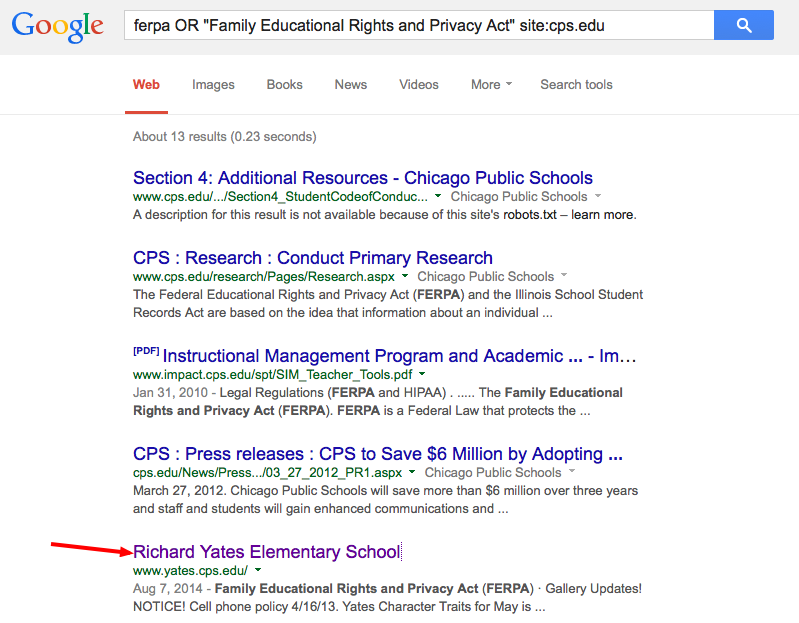
Our method is pretty simple: start with a Google search on the term FERPA and the phrase "Family Educational Rights and Privacy Act" limited to a specific school district or charter organization.

In some cases, we would then do a follow up search using the site's native search for both terms separately: FERPA, followed by "Family Educational Rights and Privacy Act."

In the text below, we link to our searches and include screenshots so you can see what we saw.

Recovery School District

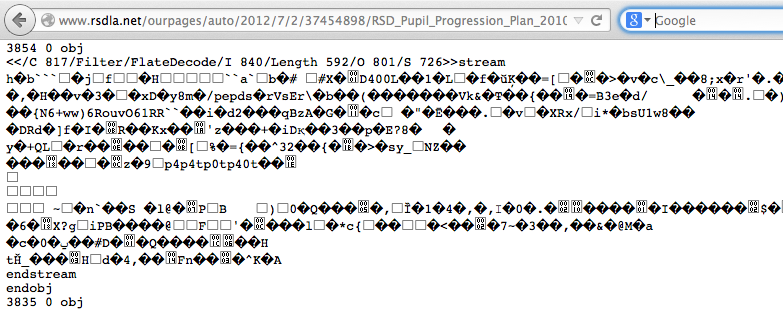
The Recovery School District returns three documents via Google. Two link to gibberish, and the third has nothing about student or parent rights under FERPA.

The Recovery School District uses Google for their local site search, so the results are identical to what we see when searching via google.com.


Education Achievement Authority

The EAA has no information about FERPA on their site.

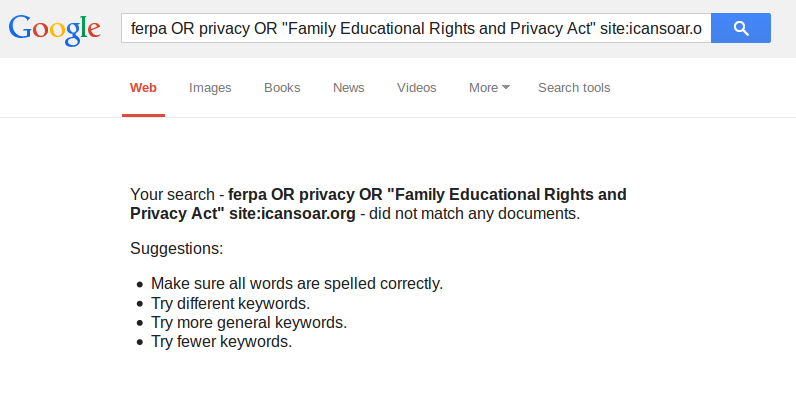
No results are returned via Google.

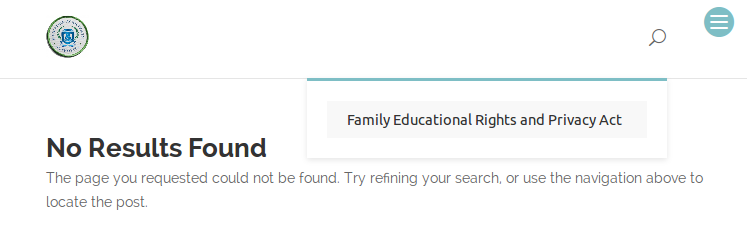
No results are returned via site search.


Rocketship Education

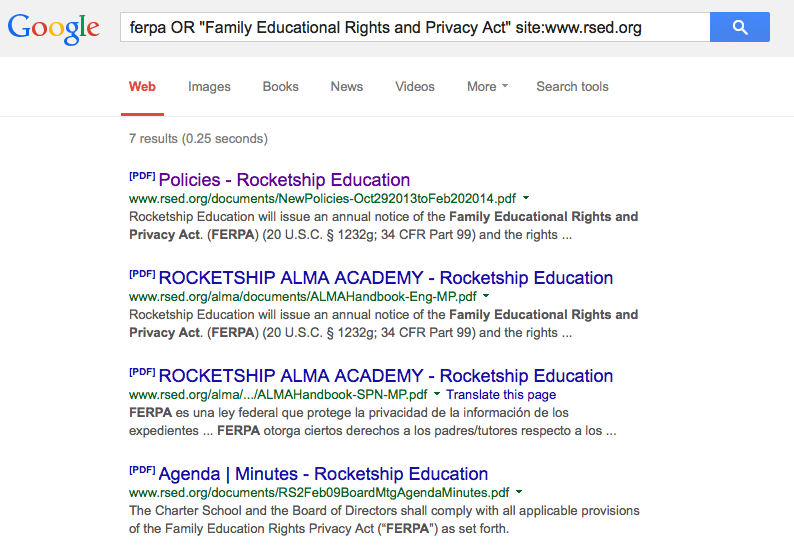
Rocketship Education returns several hits via Google, and they appear to link to pdfs for different schools. However, the pdfs appear to be scanned documents, which means that people can't search within them using the "Find" feature of their web browser. As a result, the only way to find anything is to scroll through and skim each page, which is pretty laborious. This could be fixed by using actual html pages, having their docs available as read-only Google docs, or even uploading pdfs that have been generated directly from word processing software.

Several results are returned via Google, and I found FERPA information in their "Policies" document, which is the first result returned by Google.

Rocketship Education has no obvious site search on their site.


Aspire Schools

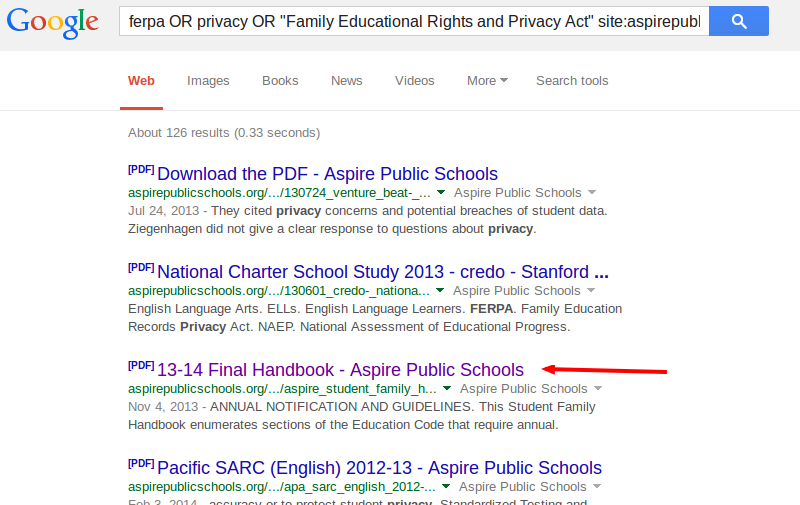
Aspire Schools fares pretty well when searched via Google.

Several results are returned via Google, and the third hit is for their student handbook, which includes FERPA information on pages 27-28.

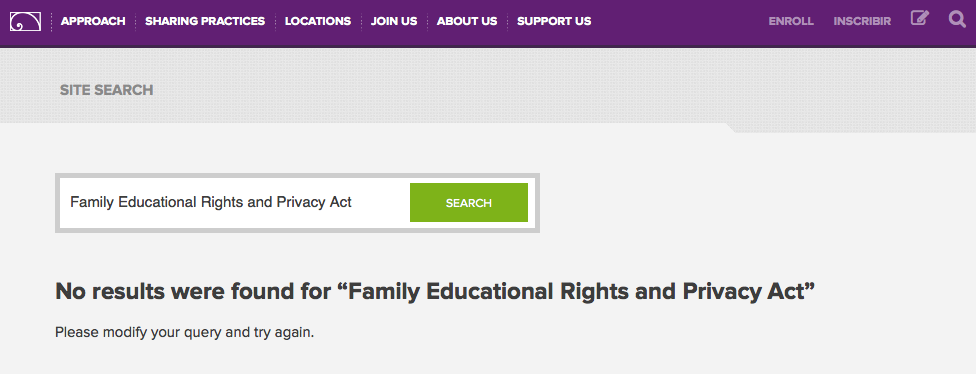
However, their site search returns nothing, which is not very useful.


Green Dot

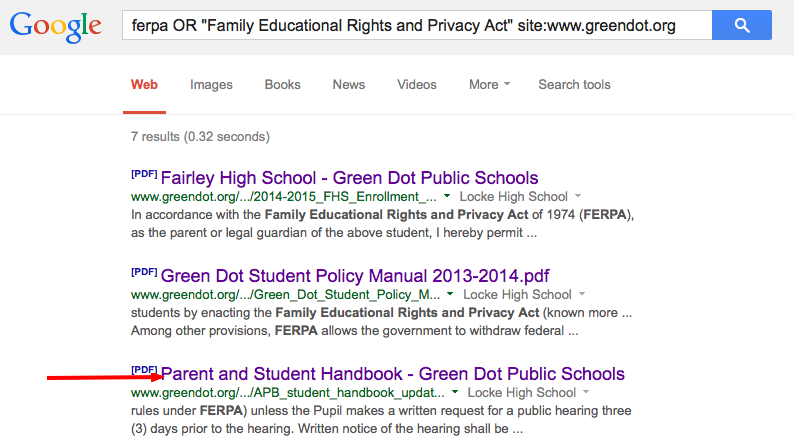
Green Dot returns several results via Google. The third hit links to the Student Policy Manual, a 125 page pdf that appears to mention FERPA several times without specifying student and parent rights under FERPA. My method for searching this doc was to use the "Find" feature in my browser, however, so if the language on FERPA was added as an image when they were creating the PDF, I would not see it.

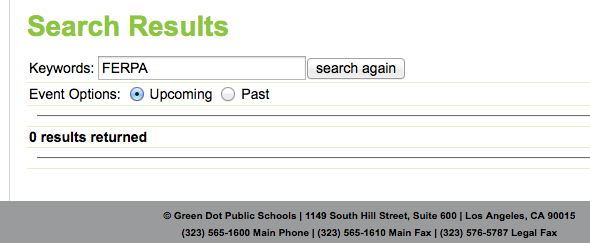
No results are returned via site search.


Success Academy Charters

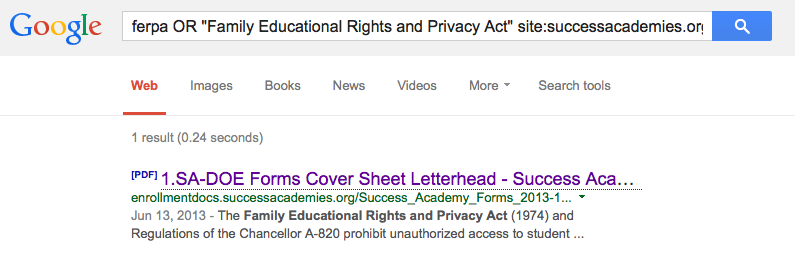
The Success Academy Charters return one result via Google. However, this document does not contain any information on parent or student rights under FERPA.

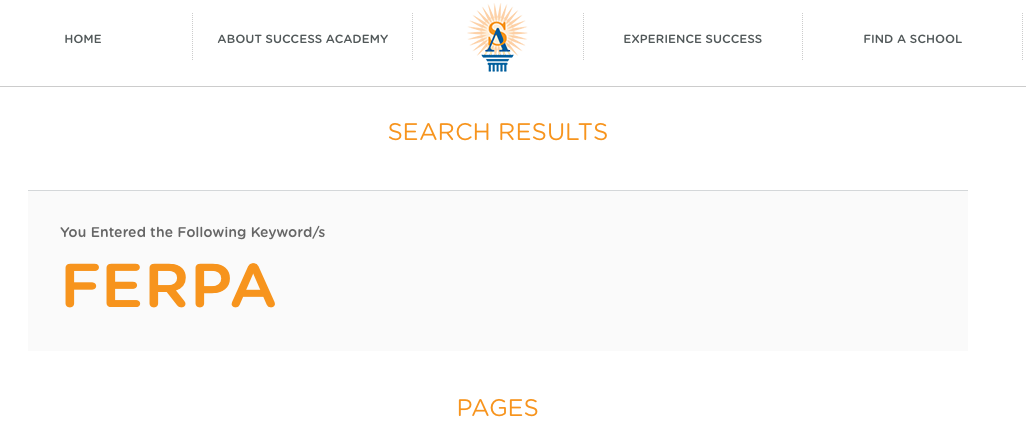
The site search returns no results.


KIPP

KIPP is a slightly different setup because it has the the main KIPP site, with local sites broken down by region.

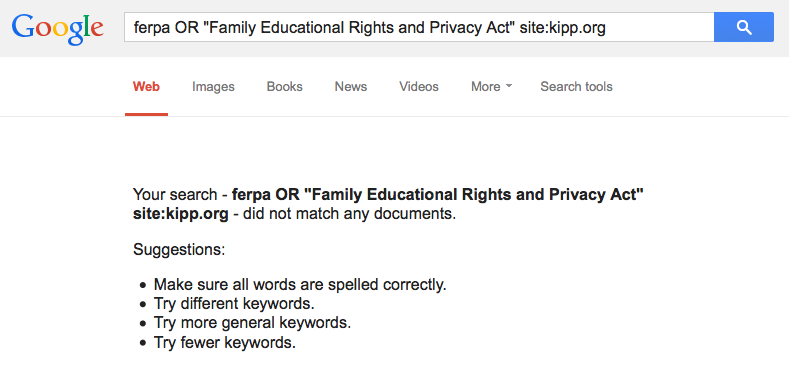
The top level KIPP site has no results for FERPA via Google.

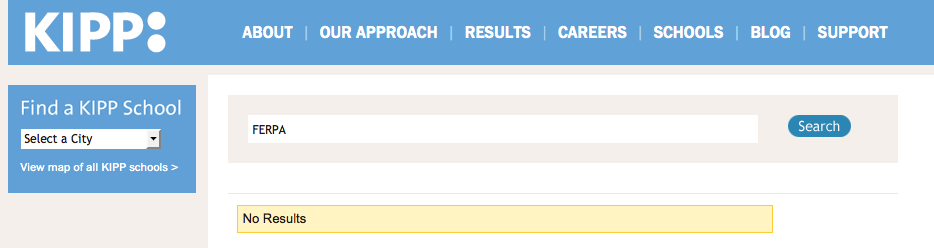
The top level KIPP site also has no results via site search.

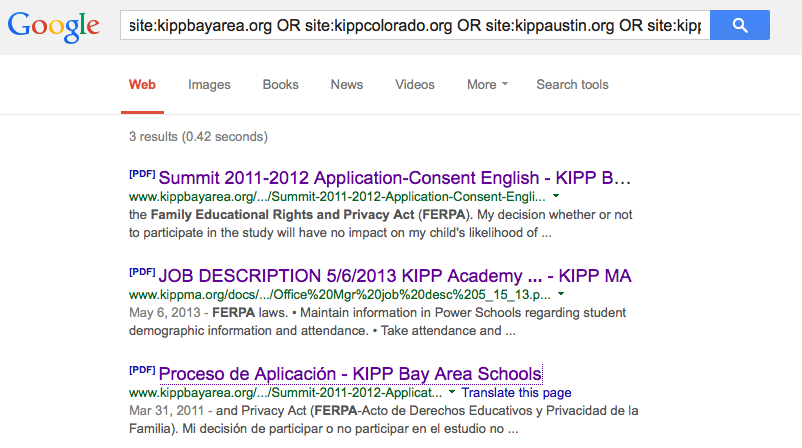
However, it's possible that the regional sites could have FERPA information - to get a sense of what the local sites shared about FERPA rights online, we can look at what comes back when we search 5 regional sites. Each regional site covers multiple schools; this search covers KIPP in Massachusetts, the San Francisco Bay Area (including San Jose), Colorado, Austin TX, and Chicago IL.

This search returns three hits. None provide any information about parent or student rights under FERPA; two of the hits are a form (in Spanish and English) asking parents to renounce their rights under FERPA so their students can be included in a Mathematica Policy Research study.


YES Prep

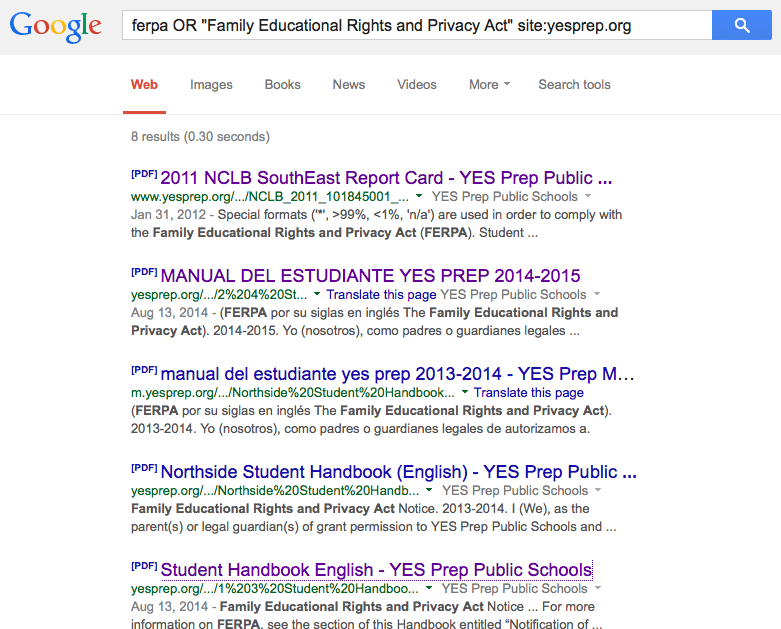
YES Prep returns several results via Google. Included in these results are links to both English and Spanish language versions of their student handbooks. Both handbooks contain detailed information on FERPA, and also mention that students and parents have the right to opt out of directory information.

Other schools would do well to follow YES Prep's example here.

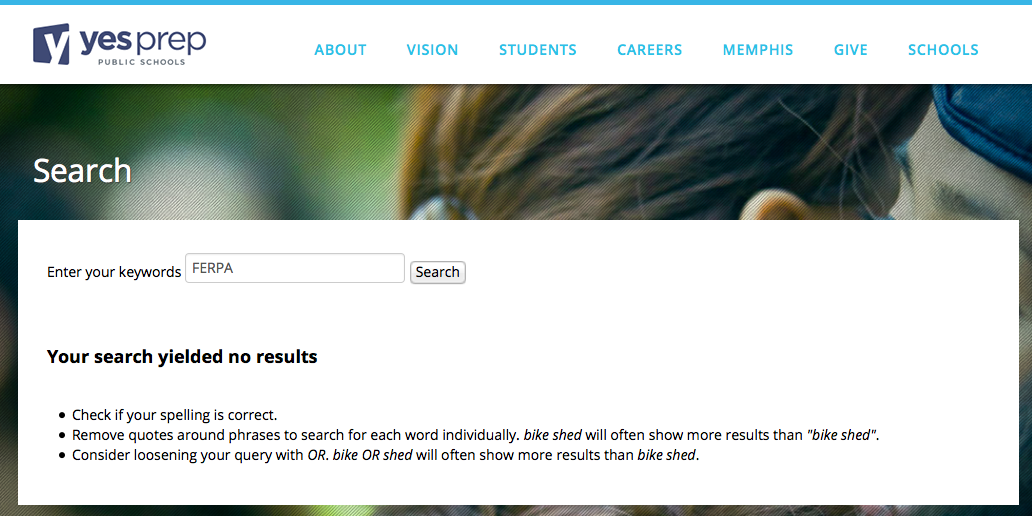
Unfortunately, YES Prep's native site search does not return any results.

On a technical note, if the YES Prep web team is reading this: your site runs Drupal. You could probably add this module to search within attachments.


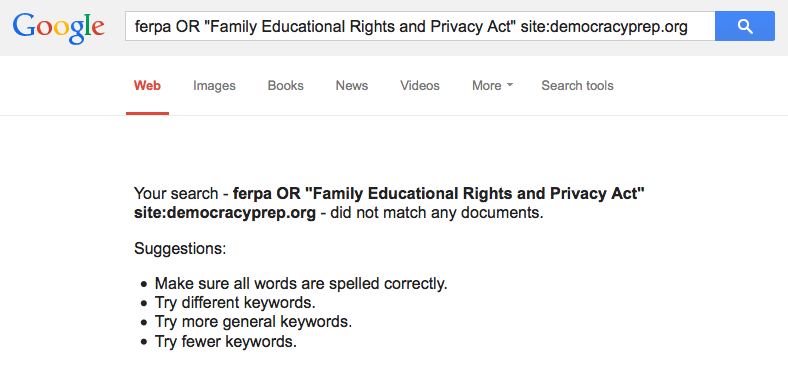
Democracy Prep shows no results via Google.

And, Democracy Prep has no obvious search feature on its home page.


Concept

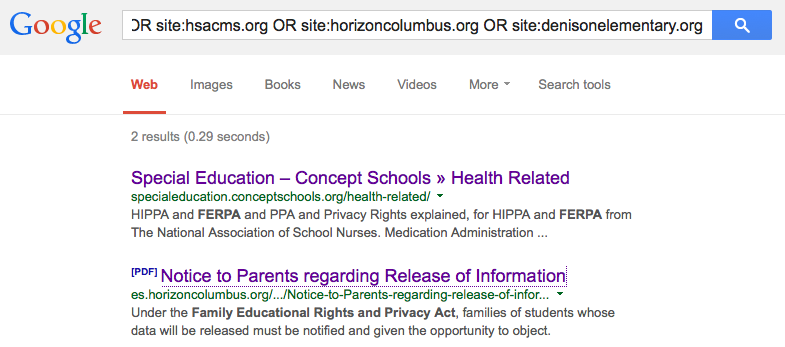
The Concept web presence is organized like KIPP; it has the main organization site in one domain, with schools at other domains. To get a sample, we searched through a subset of sites (the main organization site and five regional sites). Searching via Google brings up two hits; one is a web page that contains a variety of legal links, including two about FERPA. The second hit is a document only posted for the Columbus, Ohio schools in response to an Ohio legal case.


Uno

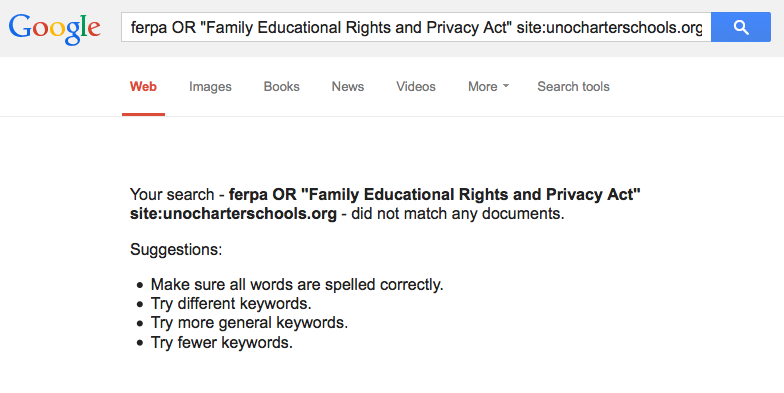
Uno Charter Schools show no results via Google.

Additionally, no results are returned via site search.


Noble Charter Schools

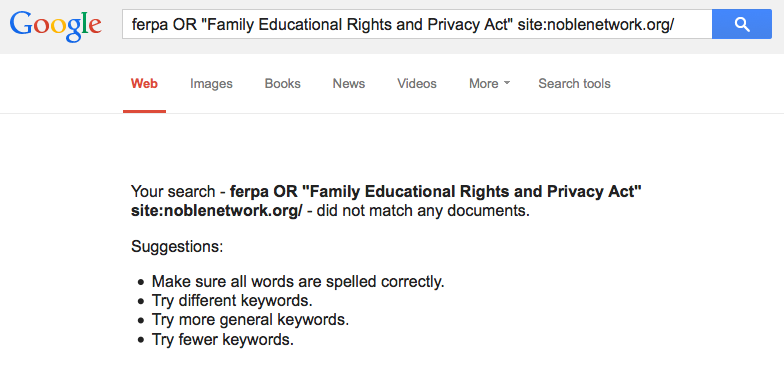
Noble Charter Schools show no results via Google.

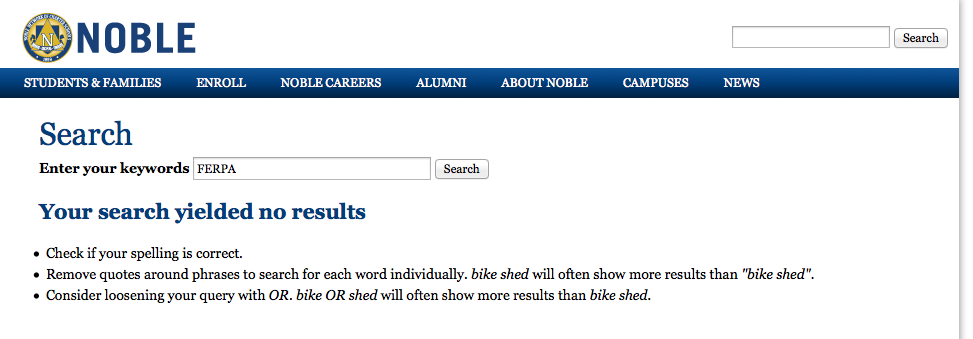
Noble shows no results via site search.


Urban Prep

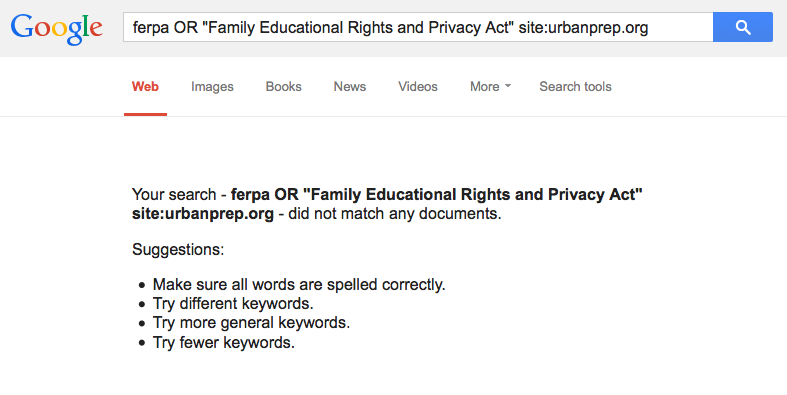
Urban Prep shows no results via Google.

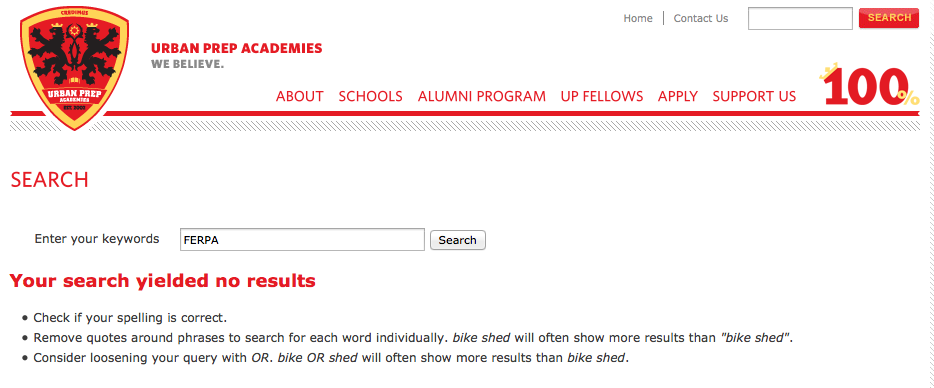
Urban Prep shows no results via site search.


Chicago International Charter Schools

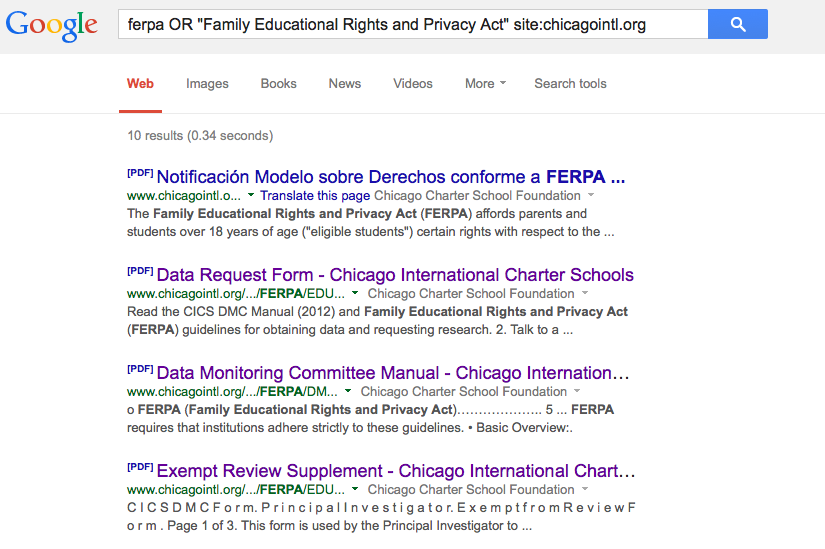
The Chicago International Charter Schools return many hits via Google. The first hit is an English and Spanish version that outlines basic FERPA rights, but does not mention the right to opt out of directory information. However, many of the the other hits on the page are forms that can be used to request access to data as part of research, including this form to avoid review by the data monitoring committee.


Chicago Public Schools

Chicago Public Schools shows several results via Google, but no information on FERPA at the district level. One school within CPS shows up; the link leads to the school's information on FERPA. Based on this review, the CPS site does not have any obvious resources online showing students and parents their rights under FERPA.


Los Angeles Unified School District

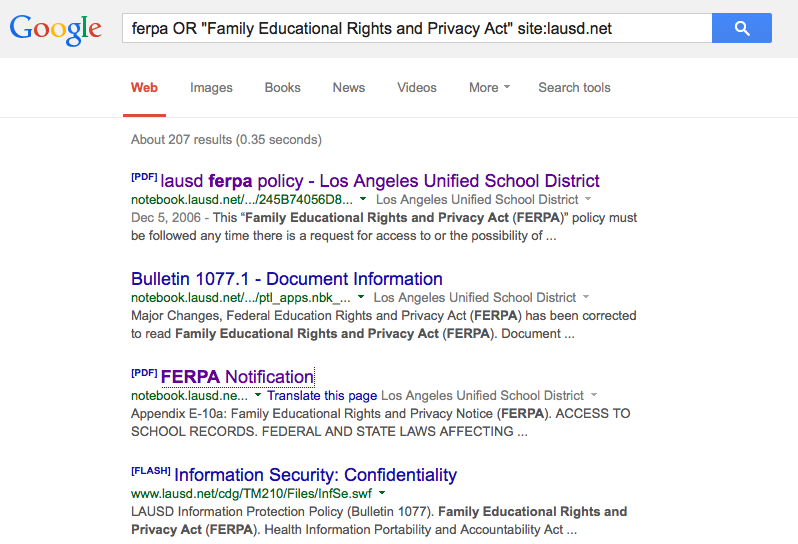
Los Angeles Unified School District returns immediately relevant results via Google. The top hits include both information on FERPA and information on the review process. The LAUSD documentation also flags that students and parents can opt out of directory information.

So, while LAUSD has a hard time with technology acquisition and Student Information Systems, the visibility of their FERPA information is something that other districts would do well to emulate.


Portland

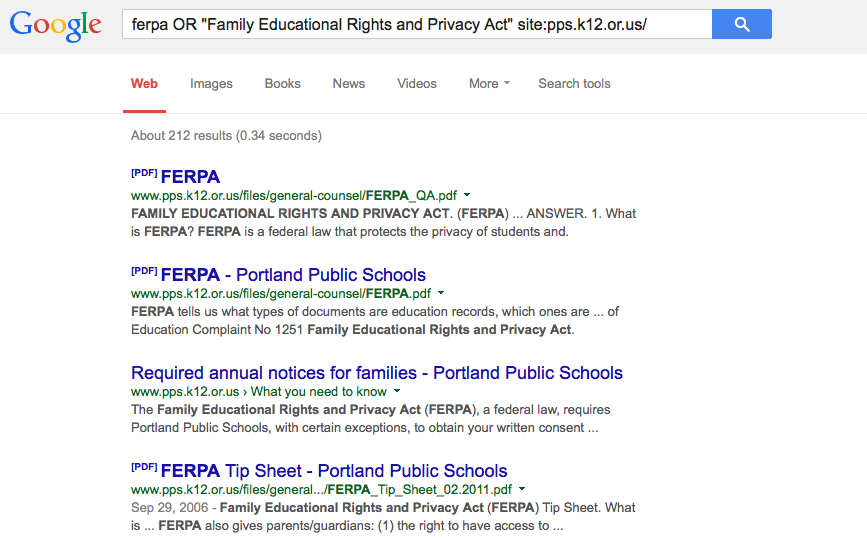
Portland (Oregon) Public Schools returns several relevant results via Google. The top hits are all immediately useful.


Boston Public Schools

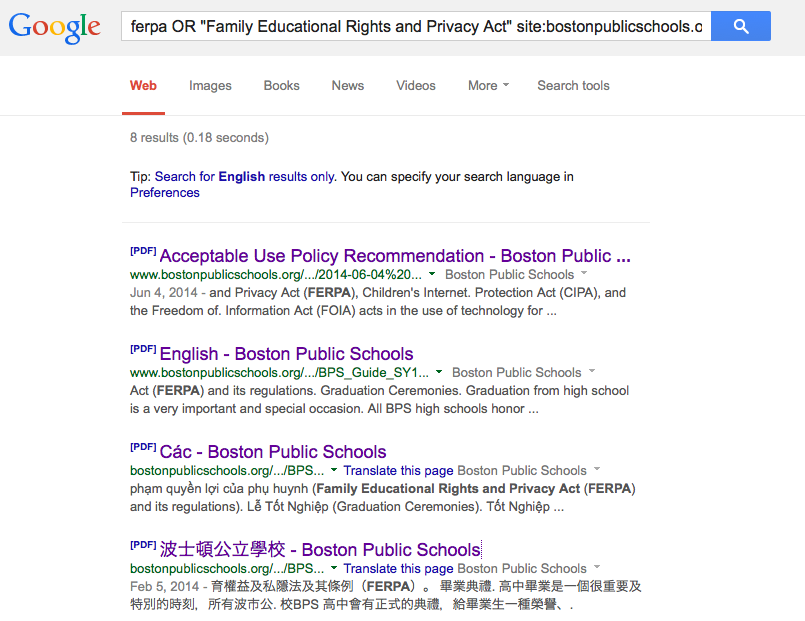
BPS gives several results via Google, including their student handbook in multiple langages. The English language version of the handbook specifies that additional information on FERPA is available in each individual school.


Dallas Independent School District

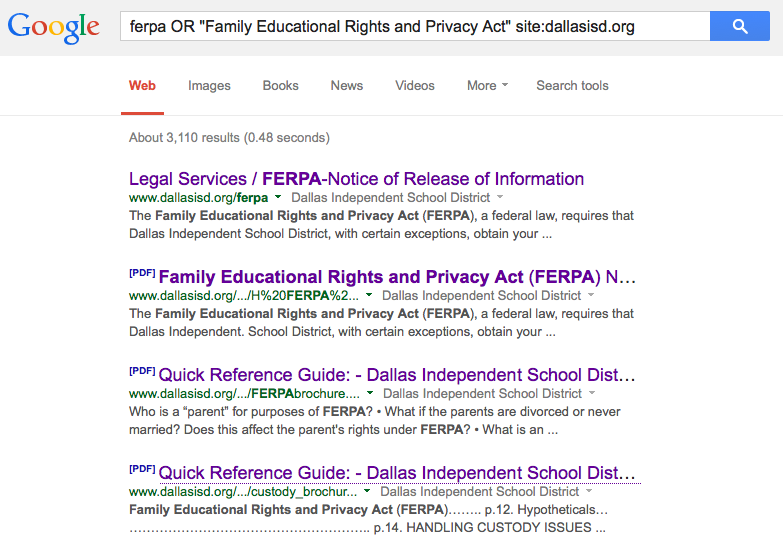
DISD returns several immediately relevant results via Google. Of all the districts and organizations surveyed here, Dallas provides the most complete and helpful set of materials. They include a set of brochures on what FERPA means, an opt-out form for directory information, and their documentation includes human-readable breakdowns of the legalese. Ideally, they have versions of these documents in multiple languages.

It's also worth highlighting that they are the only organization with a page set aside to explain FERPA on their site: http://www.dallasisd.org/ferpa - over time, I suspect that this practice will become the norm.


Conclusions

Out of all the organizations and districts reviewed here, Dallas Independent School District provides the best example of how students and parents should be informed about FERPA online. The things they do right include:

  • Set aside a page for FERPA information, at a URL (http://www.dallasisd.org/ferpa) that makes sense;
  • Include human-readable guides to FERPA;
  • Include information and a form that allows students and parents to opt out of directory information;
  • Include information defining that parents have a right to review records

It's also worth noting that, among the public school districts surveyed, the majority of them included comparable information as Dallas, just not as well organized. The notable exception was Chicago Public Schools, where district-level information was not readily available online.

Moving on to charter school organizations, YES Prep did the best job of providing online resources. Aspire also has taken steps to make FERPA information easy to find. However, the number of high-profile charter organizations with zero information available online about FERPA is an oddly avoidable oversight. It's especially troubling given how data and tech heavy some of these schools are - it's imperative that both students and parents are informed of their rights by their schools. The fact that some schools have information and forms online that are used to remove parental rights under FERPA without any accompanying information that defines those rights is especially problematic.

And, it's also worth noting that FERPA rights can be given to parents offline, on paper. It's also possible that there are other places where schools are sharing this information online that did not get seen in this review. However, privacy concerns are going to increase, and schools need to be ahead of these concerns. Sharing accurate, useful information online is an easy step to take.